
From Opaque Service Accounts to Sovereign Party Nodes
Traditional enterprise deployments rely on monolithic, opaque service accounts or static API keys. This architecture creates an insurmountable attribution void: when an AI agent hallucinates an unauthorised settlement, the core cannot determine if the fault was human error, API misconfiguration, or cognitive drift.
Zenjin dismantles this failure mode by elevating the autonomous agent into a sovereign Party Node within the BIAN++ Extended Banking Framework. Subject to real-time Continuous Digital KYC and bound by Triadic On-Behalf-Of (OBO) tokens, Zenjin guarantees that every agentic act carries unambiguous, court-admissible human principal liability.
Registered in the Registrar's Graph-of-Graphs alongside human and corporate entities.
Hardened RFC 8693 OBO tokens cryptographically binding Agent, Human, and Policy Hash.
The Active Conscience of the Symphony
Within the System of Intelligence (SoI), Zenjin Guardian acts as the active conscience and constitutional sentinel. While the iEngine reasoner proposes complex plans and DRAGON enforces judicial law, Zenjin wraps every potential state change in a protective "Mantling Posture" of institutional restraint.
By prioritising boundary preservation over unconstrained optimisation, Zenjin neutralises predatory nudges, halts unauthorised credential chaining, and eliminates prompt injection attacks before proposed intents can reach the execution plane.

Separation of Cognitive Powers: iEngine, Zenjin & DRAGON
The Constitutional Operating System separates cognitive processing into three structurally isolated, mutually checking subsystems to eliminate single points of failure and runaway autonomous reasoning:
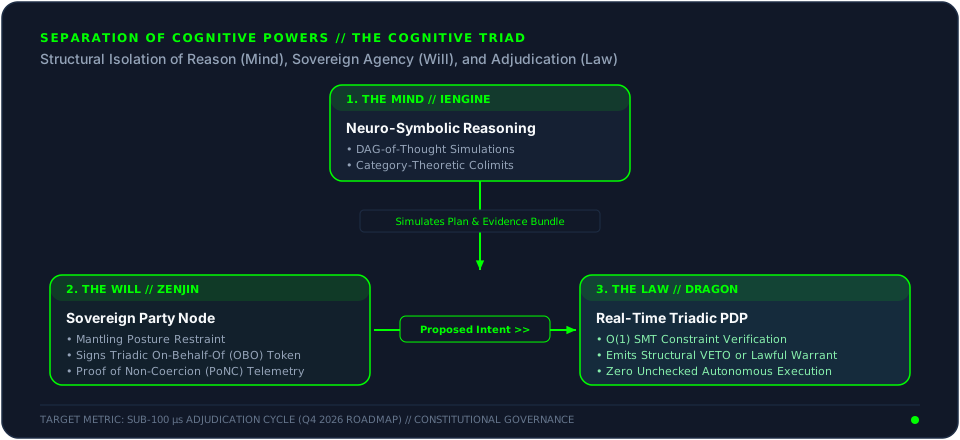
Neuro-Symbolic Reasoning
Evaluates multi-modal telemetry and produces structured DAG-of-Thought plans. Structurally Authority-Poor: it generates wisdom and simulations but is strictly forbidden from mutating system state or executing actions independently.
The Conscious Guardian
Acts as the legal wrapper and moral conscience. It assesses iEngine plans against active customer consent and institutional restraint parameters, affixing its cryptographic Party Node signature to formulate a Proposed Intent.
Triadic Adjudication Gate
The ultimate Policy Decision Point (PDP). Evaluates Proposed Intents in constant time (\(O(1)\)) against the compiled Axiom MESH constitution. If valid, DRAGON mints a Lawful Warrant; if prohibited, it triggers a hardware Structural VETO.
The 24/7 Governance Flywheel: Closed-Loop Evolution
Zenjin Guardian drives the platform's self-improving Governance Flywheel, translating real-time edge telemetry into verified constitutional amendments without manual log archaeology:
TopHAT & oneCDE Foundry
Business, legal, and engineering leaders co-author machine-executable Agreement Directed Acyclic Graphs (ADAGs) and formal deontic constants in oneCDE Stanza IDE.
Registrar & 4D xBOMs
Ratified axioms and model parameters are versioned in the System of Record (SoR) alongside cryptographic Software (SBOM), Model (AI/ML-BOM), and Data (DBOM) manifests.
DRAGON & Conductor
DRAGON verifies execution frames in real-time. The Conductor engine executes validated Actuator DAGs across Packaged Business Capabilities (PBCs).
inSight 360° & Zenjin
Zenjin analyses adjudication telemetry, detects systemic edge friction, and generates mathematical Axiom Refinement proposals sent directly back to TopHAT.
Triadic On-Behalf-Of (OBO) Token Binding
To execute an action, Zenjin cannot act alone. Every operational frame must bundle a hardened, RFC 8693-compliant Triadic Binding Payload structurally secured within the token claims:
- Subject (\(\text{Sub}\)): The immutable PartyID of the executing Zenjin Agent Node.
- Principal (\(\text{ActAs}\)): The explicit PartyID of the delegating human operator or customer.
- Policy Hash (\(\Delta_{\text{Agreement}}\)): The 256-bit cryptographic hash of the active Agreement DAG.
The Protective Mantling Posture
Derived from heraldic defence and biological sheltering, the Mantling Posture inverts conventional AI optimisation. Success is measured not by transaction speed, but by absolute boundary preservation:
Restraint Over Optimisation
If an efficient execution path presents a non-zero probability of regulatory conflict, Zenjin defaults to immediate pause and TopHAT human escalation.
Proactive Cognitive Shielding
Protects human agency against dark patterns, manipulative reinforcement learning nudges, and prompt injection attacks under EU AI Act and GDPR Article 17 mandates.

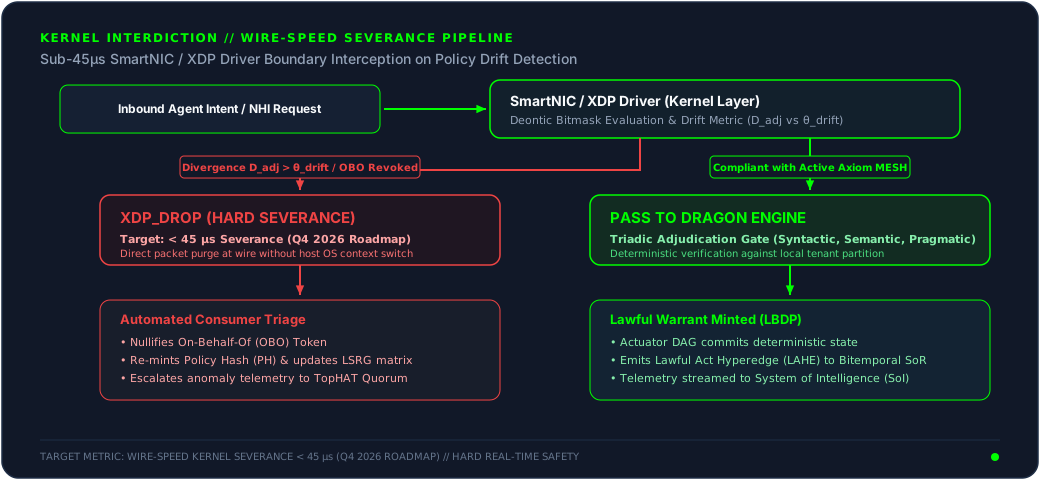
Adjudication Divergence (\(D_{adj}\)) & Wire-Speed Kernel Severance
Zenjin continuously monitors active agent execution against compiled Axiom MESH invariants using Kullback-Leibler divergence. If drift exceeds safety threshold \(\theta_{drift}\), eBPF kernel hooks drop packets in target sub-45 microseconds:
Deontic Formal Bisimulation & Divergence Proofs
Satisfiability Modulo Theories (SMT) solver proofs, Kullback-Leibler drift monitoring, and eBPF wire-speed policy drop benchmarks have been compiled into the Deep Tech Series.
The Non-Negotiable Financial Trust Engine
Every phygital, civic, healthcare, retail, or agentic interaction ultimately resolves into a lawful value exchange, identity binding, or fiduciary settlement. The Salient FinTech Innovation Set provides the core rails.

BIAN v14.0 Party State Model
Zenjin Guardian implements BIAN Service Domains (Party Authentication, Position Keeping, Party State Management) as bare-metal state machines, verifying that every agent acts under valid fiduciary mandates.

A2A Rail Guardianship
Real-time transaction monitoring on instant payment rails (SEPA Instant, Faster Payments, FedNow) ensuring that high-velocity autonomous payments cannot exceed client-allocated limits or violate PSD3 fraud rules.

Token Gantry Custody Enclaves
Direct cryptographic interface to the Token Gantry (SoE). Zenjin guarantees that value tokens and cryptographic rights can only be unwrapped inside attested TEEs with multi-party quorum signoff.
GreenOps & The Runtime Carbon VETO
Enforcing real-time carbon telemetry, grid emission factor alignment, and automated execution halts when inference budgets breach environmental thresholds.
Workload Carbon Attestation
Zenjin monitors the operational carbon intensity of underlying hardware enclaves (SmartNICs, DPUs, GPU clusters). Each cognitive proposal from iEngine includes an estimated energy envelope calculated from model parameter count and token throughput.
The Runtime Carbon VETO
If grid marginal emissions exceed agreed tenant policy thresholds during regional peak load, Zenjin issues an automated execution VETO, shunting non-critical agent reasoning to green-powered regional nodes or deferring execution to lower-carbon windows.
4-Tier STRM Cohort Crosswalk & Sector Realisation
From single-institution pilot deployments to multi-tenant sovereign infrastructure networks.
Genesis Anchor
Single-tenant Zenjin Guardian instance deployed in on-premises TEE hardware, monitoring internal LLM reasoning and employee assistant tooling.
Bilateral Mesh
Cross-party OBO token negotiation between primary financial institution and tier-1 vendor enclaves with mutual divergence logging.
Multi-Tenant Network
Distributed Guardian deployment across POI Appliances, Smart Terminals, and edge nodes coordinating retail and civic ecosystems.
Sovereign Infrastructure
Jurisdictional-scale deployment supporting inter-cohort settlement, automated cATO compliance, and cross-border digital identity.
Sector Application Mapping
Technical Disclosures & Formal Bisimulation Proofs
Mathematical grounding proving non-transitivity, divergence bounding, and kernel enforcement invariants.
| Capability Dimension | Legacy Agent Monitors | Zenjin Guardian Architecture |
|---|---|---|
| Delegation Model | Transitive bearer tokens (OAuth 2.0 / API Keys) | 1-Hop Scoped OBO Envelopes with Sig_{Client} |
| Severance Speed | Post-facto log scraping (5s – 15 min delay) | Wire-speed eBPF ring-0 cutoff (< 500 μs target) |
| Cognitive Separation | Self-evaluating prompts within same LLM context | Strict separation: iEngine (intent) vs DRAGON (law) |
| Audit Trail | Mutable text log files in cloud storage | Bitemporal cryptographic hyperedges committed to SoR |
Theorem 1: Non-Transitivity of On-Behalf-Of (OBO) Delegation Envelopes
Let $P$ be a principal party node, $A_1$ be an appointed primary agent, and $A_2$ be a downstream sub-agent. The authorisation relation $\mathcal{R}_{auth} \subseteq \mathcal{P} \times \mathcal{A}$ is non-transitive:
Every valid transaction warrant $W$ must contain an unbroken chain of client-signed predicates $\sigma_P(A_1, C)$ where $C$ is the specific contract envelope. Sub-delegation by $A_1$ yields $\sigma_{A_1}(A_2, C)$, which the Zenjin Guardian kernel strictly evaluates as an unauthorised state transition, halting the transaction at the network membrane.
Theorem 2: Formal Bisimulation of Deontic Dominance Constraints
Let $\mathcal{M}_{intent}$ be the transition system of the cognitive proposal engine, and $\mathcal{M}_{deontic}$ be the transition system generated by the Agreement DAG. A bisimulation relation $\sim \subseteq S_1 \times S_2$ exists if and only if for all $(s_1, s_2) \in \sim$:
Under Zenjin Guardian, whenever an action $\alpha$ violates a deontic prohibition ($\mathbf{F}(\alpha) \succ \mathbf{O}(\alpha)$), no valid successor state $s_2'$ exists in $\mathcal{M}_{deontic}$. The bisimulation breaks, $D_{adj} \to 1$, and the severance membrane drops the socket descriptor within wire-speed tolerances.
Persistent System Value Across All Cohorts




The Conscience of the Machine Principle
In an autonomous digital economy, intelligence without constitutional constraint is an unacceptable balance-sheet liability. An autonomous system cannot be trusted simply because its underlying foundation model was fine-tuned with reinforcement learning from human feedback. True institutional safety requires that the power to act is constitutionally separated from the power to decide, and that execution can be severed instantly at the kernel level.
Zenjin Guardian provides this non-negotiable architectural separation. It turns legal and regulatory obligations from retrospective audit questionnaires into living, wire-speed physical gatekeepers.