



Silicon â Enforced Integrity & Active Governance: Reclaiming Enterprise Velocity
Modern enterprise security is failing at the boardroom level because compliance remains locked in a manual, retrospective loop. Traditional security teams spend millions of euros annually on periodic log audits, vulnerability scans, and static reports â catching compliance failures long after an exploit window has opened.
Posture 360°°º transforms security from a slow operational brake pedal into an automated, silicon-anchored competitive advantage. Operating specifically at SABSA Layer 6 (the Operational Layer), it moves beyond software monitoring by baking automated Deontic logic constraints directly into physical computing hardware. By seamlessly orchestrating The Registrar, inSight 360, and The Inspector, it eliminates the exploit window between written policy and execution â translating regulatory compliance (DORA, NIS2, eIDAS 2.0) into an insurable, real-time risk profile.
80%+ Audit Reduction
Replaces manual, multi-week compliance audit cycles with continuous, cryptographically attested proof of posture across all cloud and edge environments.
Instant Blast Radius Severance
Automatically revokes Continuous Authorisation to Operate (cATO) in under 1ms target latency (Q4 2026 roadmap) upon configuration drift, severing compromised nodes instantly.
Insurable Autonomy
Translates statutory mandates (DORA, PSD3, eIDAS 2.0) into non-derogable hardware rules, providing institutional clearing partners with guaranteed compliance.
Constitutional Placement: The Symphony â Separation of Powers
Within the Constitutional Operating System (COS), Posture 360°°º operates inside the System of Orchestration (SoO) at SABSA Layer 6 (Operational Layer). It is not an out-of-band reporting dashboard; it is an active execution runtime coordinating deterministic execution, boundary enforcement, and dynamic event routing across three core primitives.
| Constitutional Branch | Symphony â System | Operational Role |
|---|---|---|
| The Legislative | System of Agreement (SoA) | Compiles statutory law, BIAN models, and NGAC policies into non-contradictory Agreement DAGs. |
| The Sensory | System of Engagement (SoE) | Ingests physical edge telemetry via inConcert iPaaS without storing PII. |
| The Judiciary | System of Intelligence (SoI) | Evaluates intents against active rules; DRAGON Engine issues signed warrants or Structural VETOs. |
| The Executive | System of Orchestration (SoO) | Authority-poor, execution-rich: Drives Conductor, GateKeeper, and Flow360 to enforce runtime physics. |
| The Archive | System of Record (SoR) | Records state transitions as immutable Lawful Act Hyperedges (\(T_v \times T_t\)). |
Conductor (Deterministic Execution)
Holds zero discretionary authority. It compiles multi-step self-healing runbooks into discrete Stanzas and Strophes, executing actions only when supplied with a cryptographically signed Lawful Warrant from the DRAGON Engine.
GateKeeper (Boundary Enforcement)
Translates active NGAC policy graphs and Posture360 scores into Cilium Tetragon eBPF kernel maps. It enforces the Canonical Dominance Order (\(\mathbf{F} \succ \mathbf{O} \succ \mathbf{P}\)) at the network driver and system call layer, issuing XDP_DROP commands in under 45 microseconds target latency (Q4 2026 roadmap).
Flow360 (Dynamic Event Mesh)
Provides message ordering and partition management. When posture drift occurs, Flow360 broadcasts atomic map updates to isolate degraded appliances into sandboxes without dropping valid multi-tenant traffic.
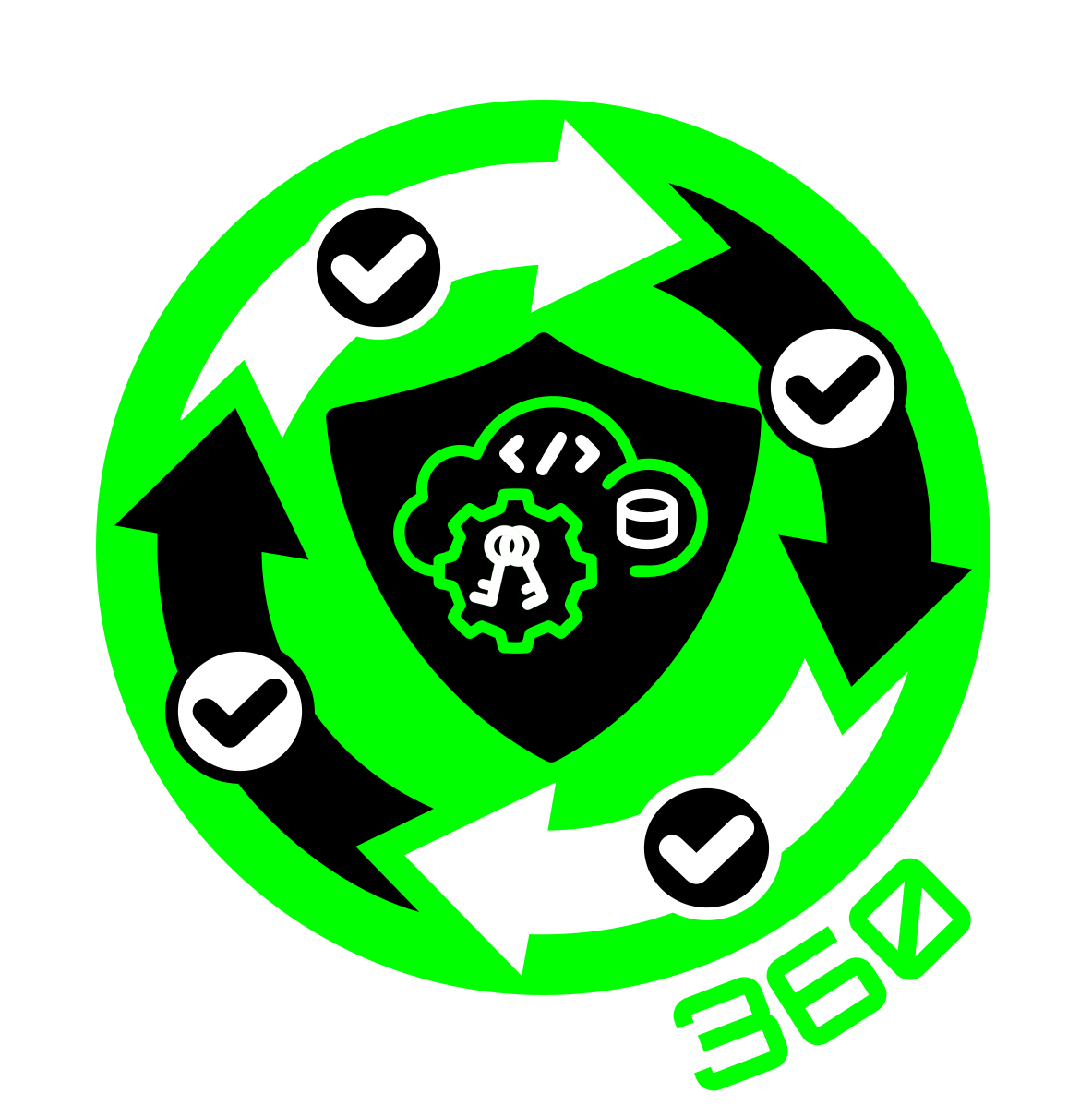
Posture 360°° Runtime Manifest
Real-Time Risk & Compliance Posture
The xBOM Quintet & PBOM Recursive Assurance Lattice
Posture 360°°º binds runtime execution to five cryptographically linked Bills of Materials managed by the Registrar. Operating under a strict "No xBOM, No Deploy" gate, the composite Package Bill of Materials (PBOM) aggregates child BOM risk metrics using topological sorting to produce a unified SABSA business assurance profile. If a single child leaf drifts, the parent PBOM status fails, instantly revoking the node's Continuous Authority to Operate (cATO).
PBOM (Package/Product Root Node)
Functions as the composite root node. It aggregates child BOM risk metrics using topological sorting to produce a unified SABSA business assurance profile. If a single child leaf drifts, the parent PBOM status fails, revoking the node's Continuous Authority to Operate (cATO).
HBOM (Hardware)
Captures TPM 2.0 measured-boot registers (\(PCR_0\) through \(PCR_7\)), CPU TEE capabilities, FIPS 140-3 enclave status, and physical environmental telemetry at Point of Interaction appliances.
SBOM (Software)
Tracks source dependencies, shared libraries, CEN/XFS4IoT driver stacks, and SHA-256 binary signatures of all WebAssembly (WASM) modules prior to runtime execution.
MBOM (AI Models)
Enforces AI governance under EU AI Act Article 50 and ISO 42001. Tracks training data lineage, quantisation boundaries, and Lyapunov stability invariants for continuous-time Liquid Neural Networks (Neural ODEs).
DBOM (Data Products)
Validates W3C SHACL constraint shapes, geographical residency rules (GDPR/DORA), and active user consent directives compiled from oneWallet.online Personal Knowledge Graphs.
In-Kernel Enforcement: The Triadic Adjudication Pipeline
Every execution request and network frame traverses a rigorous three-stage adjudication pipeline before kernel resources are allocated, combining line-rate DPU packet inspection, confidential enclave ontology binding, and constant-time hardware ASIC verification.
Line-Rate Schema Match
Validates packet layout against canonical schemas (ISO 20022, NEXO) and verifies SPIFFE/SVID identity credentials at wire-speed. Malformed or unauthenticated packets are dropped at the network edge with zero host CPU load.
Ontological Grounding
The KnowledgeHUB maps payload variables to BIAN-aligned service domain ontologies, preventing parameter manipulation, prompt injection, and semantic spoofing across distributed execution boundaries.
Constant-Time Context Checks
Evaluates runtime context (PTP high-precision timestamps, geofence polygons, and risk scores) against active Agreement DAGs in constant time (\(\mathcal{O}(1)\)) via hardware SRAM bitmasks:
Valid requests receive a single-use Lawful Warrant (PERMIT). Violations trigger an immediate Structural VETO, invalidating memory page pointers and un-muting peripheral device ports only for authorised stanzas.
cATO Synchronisation Physics
When a vulnerability or posture shift is detected, the Continuous Authorisation to Operate (cATO) engine executes atomically:
Asset Mismatch
InSight 360 or edge telemetry flags firmware degradation or zero-day drift.
Trust Revocation
Registrar revokes active trust coordinates and re-mints the global Policy Hash (PH).
Sub-ms Push (Target Metric)
Updated PH coordinate is pushed directly to edge SmartNIC DPUs & eBPF maps in under 1 millisecond target latency (Q4 2026 roadmap).
Atomic Halt
In-flight operations failing cryptographic checks trigger an instant execution halt (SIGKILL).
Regulatory Compliance & Capital Optimisation
Posture 360°°º maps runtime enforcement directly to prudential risk management and European regulatory standards, turning compliance verification from a cost centre into measurable balance-sheet relief.

Basel IV Capital Allocation
Operational risk capital under Basel IV is governed by the Business Indicator Component (\(BIC\)) and Internal Loss Multiplier (\(ILM\)). By preventing operational loss events deterministically at the kernel layer, institutions justify locking the \(ILM\) at its optimal baseline floor (\(ILM = 1.0\)). Transactions verified as Lawful Act Hyperedges (LAHEs) qualify for a 20% collateralised credit risk weight under the Standardised Approach.
DORA & NIS2 Compliance
Resilience requirements are met through Constitutional Island Mode. Edge appliances operate autonomously during WAN outages using local Delegated Axiom Sets (DAS), reconciling state upon reconnection via Merkle-CRDT synchronisation with zero risk of transaction divergence.

GDPR Art 17 (Right to Erasure)
Resolved via Asymmetric Cryptographic Erasure (PAIF). PII is stored inside TEE-bound Sovereign Envelopes encrypted under ephemeral node keys (\(K_{\text{node}}\)). Triggering an erasure request shreds \(K_{\text{node}}\) inside the enclave, rendering on-chain hyperedge hashes irreversible without compromising Merkle DAG integrity.
Human-System Resilience: The SOC iRest Protocol
Posture 360°°º directly addresses human operational fatigue within Security Operations Centres (SOCs) through automated triage, deterministic causal graph visualisations, and restorative cognitive support protocols.
Alert Noise Elimination
Because non-compliant state transitions are blocked at the eBPF kernel layer, low-priority compliance drift alerts are eliminated, leaving only high-context anomalies for review.
Deterministic Causal Chains
Causal AI traverses the Control Flow Knowledge Graph (CFKG) to present incident root causes, affected assets, and blocked exploit vectors as coherent topological graphs rather than raw log streams.
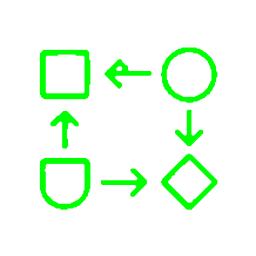
Integrated iRest Workflow
The System of Intelligence monitors analyst workload, case velocity, and error rates to assess cognitive fatigue. During prolonged high-severity incidents, the platform automates recovery via 10-step Integrative Restoration (iRest) decompression nudges and dynamically rebalances case assignments across cohort teams. Target operational performance metrics correlate mindfulness intervention with reduced Mean Time to Resolution (MTTR) and lower triage error rates (Q4 2026 roadmap).
Posture360 Across SoA, TRS-MS & SoO
Posture 360°°º functions under the combined jurisdiction of the System of Agreement (SoA), Trust, Risk, and Security Management System (TRS-MS), and System of Orchestration (SoO) to translate legal rules into physical execution.
Policy Codification
Codifies Next Generation Access Control (NGAC) substrate classes. PIME pre-compiles security rules into sparse Legal-State Reachability Graphs (LSRG) written directly into DRAGON ASIC SRAM Hives.
Runtime xBOM Evaluation
Houses the active monitoring loops of Posture 360°°º, continuously auditing HBOM hardware, SBOM binaries, MBOM models, and DBOM consent envelopes.
Kernel Interdiction
Pushes real-time verdicts directly to network kernels via eBPF maps, directing Conductor, GateKeeper, and Flow360 to isolate non-compliant nodes instantly.
Formal Bisimulation & Attestation Proofs
Detailed mathematical formalisms, SMT Z3 solver traces, and hardware memory-shredding specifications have been offloaded to the Deep Tech Series.
The 10 Pillars of Absolute Assurance
Posture 360°°º enforces ten core architectural pillars to guarantee continuous cloud integrity, strict identity isolation, and hardware-bound compliance perimeters.
1. Multi-Cloud Asset Discovery: The Registrar
Unifies ITAM and CMDB schemas into a live Merkle Bi-Temporal CMDB Knowledge Graph. Enforces a non-negotiable "No xBOM, No Deploy" gate that blocks unregistered hardware or code from the network mesh.
2. Continuous Misconfiguration Prevention: Axiom MESH
Audits application states continuously against non-derogable corporate laws in the Axiom MESH. The millisecond an asset drifts, its Continuous Authority to Operate (cATO) is instantly revoked.
3. Data Posture & Privacy: Law-Bound Data Products
Packages sensitive attributes into Law-Bound Data Products (LBDPs) authorising Zero-Knowledge Proofs (ZKPs) to guarantee user consent without exposing raw PII.
4. Identity Entitlement & Least Privilege
Eliminates static, long-lived IAM keys by generating dynamic, single-use On-Behalf-Of (OBO) cryptographic tokens bound strictly to verified intent DAGs.
5. Contextual Risk Prioritisation
Replaces static alert severity scores with real-time Value at Risk (VaR) analytics derived from the Control Flow Knowledge Graph (CFKG), eliminating compliance alert fatigue.
6. Automated Remediation: Actuator DAGs
Executes deterministic, automated containment via Actuator DAGs within Conductor, rerouting compromised traffic into topologically inert isolation paths.
7. Regulatory Compliance Mapping: PIME Compiler
Translates statutory regulations (DORA, NIS2, eIDAS 2.0) into machine-executable Deontic rules (\(\mathbf{F} \succ \mathbf{O} \succ \mathbf{P}\)), guaranteeing compliance by design.
8. DevSecOps & IaC Pipeline Integration
Performs pre-deployment formal verification on Infrastructure-as-Code (IaC) templates, preventing non-compliant configurations from reaching production.
9. In-Kernel eBPF Membrane Interdiction
Inserts sidecarless eBPF bytecode directly into Linux kernel network paths, terminating unconstitutional system calls instantly (SIGKILL).
10. AI Pipeline & Model Safety
Enforces strict MBOM model weights and hardware-wired Structural VETOs to prevent autonomous AI agents from exceeding designated authority boundaries.
Legacy Security vs. Posture 360°°º
A systemic comparison of traditional security silos versus active silicon enforcement.
| Feature Domain | Legacy Enterprise Security Silos | Posture 360°°º Silicon Enforcement |
|---|---|---|
| Discovery Cadence | Reactive, periodic API log scraping and polling. | Continuous Merkle Bi-Temporal CMDB Graph via xBOM Spine. |
| Drift Management | Retrospective reporting hours after violations occur. | Target state architecture: instantaneous cATO revocation in under 1ms (Q4 2026 roadmap). |
| Access Control | Broad, long-lived, static IAM user credentials. | Ephemeral, single-use, non-transitive OBO Tokens via NGAC. |
| Enforcement Surface | Resource-heavy software agents prone to bypasses. | In-kernel eBPF/XDP interdiction executed under 45 microseconds target latency (Q4 2026 roadmap). |
Ready to Transition from Assumed Compliance to Engineered Certainty?
Posture 360°°º transforms compliance from an expensive, reactive operational brake pedal into an automated, highly predictable engine for secure business acceleration. By anchoring your digital infrastructure to a hardware-enforced corporate constitution, your global cloud estates and phygital edge appliances remain permanently secure, provably compliant, and structurally resilient.