Training the product leaders, legal engineers, and systems architects who turn AI ambition and regulatory pressure into bankable, sovereign commercial value. The Ideator Academy equips Tenant Cohort teams and independent builders with practical fluency in Constitutional AI, compliance engineering, and phygital service design.
Understanding the difference between AI that is "aligned by policy" and AI that is "constitutionally governed". Covers Agreement DAGs, Axiom MESH, and the DRAGON Engine adjudication model.
PRACTITIONER
Agentic Systems Design
Designing, deploying, and governing AI agents within the System of Orchestration. How to author Stanzas and Strophes, define agent mandates, and enforce constitutional boundaries on autonomous behaviour.
SPECIALIST
RegTech & Governance Engineering
Translating regulatory obligations (PSD3, DORA, EU AI Act, GDPR) into machine-executable axioms using the TopHAT workbench. The technical and legal fusion skills that power Constitutional RegTech.
ADVANCED
Phygital Experience Design
Designing seamless customer journeys across physical POI Appliances and digital channels. UX for biometric authentication, multi-channel session continuity, and inclusive design for all population segments.
Who the Academy Is For
From enterprise teams to independent innovators – the Ideator Academy has a pathway for you.
Unpacking the multi-tenant phygital co-creation framework, Gartner Pace-Layering strategy, and hardware-enforced carrier-grade execution plane.
The onePOI.online multi-tenant phygital ecosystem operationalises open innovation at scale by transforming standard corporate R&D into a collaborative, resource-pooled infrastructure. Managed by the Salient Innovation Set (SIS), this framework addresses the high capital expenditure and execution risk inherent in cross-sector initiatives spanning Financial Service Institutions (FSIs), Communication Service Providers (CSPs), Retailers, and Public Sector entities.
At its core, the ecosystem leverages Gartner’s Pace-Layered Application Strategy – specifically isolating the System of Innovation (SoI) layer. Rather than forcing legacy Systems of Record (SoR) to adapt at unsustainable speeds, open innovation Tenant Cohorts pool financial, technical, and regulatory assets within the Ideator Academy. Here, cohorts collaboratively prototype, stress-test, and validate new phygital product concepts (e.g., EU Corridor PPPs, CivicHUBs, Banking HUBs) using the foundational capabilities of the FinTech Innovation Set.
Ideator Academy
The DesignOps ideation and co-innovation laboratory.
Launch Works
The DevSecOps co-development, simulation, and resource-pooling engine.
oneCERT
The Cyber Supply Chain Risk Management (C-SCRM) and Software and Supply Chain Assurance (SSCA) gatekeeper.
Financial Grade Linux (FGL)
The deterministic, carrier-grade operating substrate.
Total eXperience Management (TXM)
The causal AI and agentic journey orchestration feedback membrane.
1. Gartner Pace-Layering Mapped to Multi-Tenant Open Innovation
Gartner’s Pace-Layered Architecture categorises capabilities into three speeds:
Core foundational transaction engines; strict regulatory and operational constraints
Financial Grade Linux (FGL) Substrate
Compute Control · Storage Control · Network Control
1.Systems of Record (SoR): Legacy core engines (e.g., core banking, billing systems, civic databases) that change slowly due to strict regulatory and operational constraints.
2.Systems of Engagement (SoE): Customer-facing touchpoints and orchestration fabrics that iterate rapidly based on market feedback.
3.Systems of Innovation (SoI): Ephemeral, highly adaptive environments constructed to explore emerging business models, run rapid experiments, and capture new value propositions.
In the onePOI.online architecture, the System of Innovation is deployed as an open-innovation marketplace. Tenant Cohorts – comprising complementary industries such as an FSI providing capital, a CSP providing edge connectivity, and a Retailer providing physical footprint – enter the SoI layer to test new product concepts.
By decoupling the SoI from the core SoR via abstract Agentic Interfaces and Bitemporal Hypergraph Networks (BHN), cohorts experiment without exposing core legacy infrastructure to security breaches, operational stability threats, or regulatory non-compliance.
2. Tenant Cohorts and Resource Pooling
Open innovation in the onePOI.online ecosystem relies on two resource-pooling vectors:
A. Pooled Capability Sets
High-cost, specialised domain expertise is pooled across the cohort rather than duplicated per tenant. A prime manifestation is the TopHAT (Topology of Human Assisted Trainers) network. TopHAT brings together legal, regulatory, and technical experts who co-author machine-readable governance. These rules are injected directly into the platform’s System of Agreement (SoA) as Axioms and Agreement Directed Acyclic Graphs (DAGs), offering continuous "Compliance-as-a-Service".
B. Pooled Resource Sets
Tenants co-invest in physical and edge assets. Through Launch Works, cohorts pool capital to deploy POI Appliances and Edge Compute Infrastructure. For example, an FSI expands its distribution network into rural or high-density retail corridors by leveraging a retailer's physical store footprint and a telco's edge connectivity, converting heavy individual CapEx into a shared, predictable OpEx model.
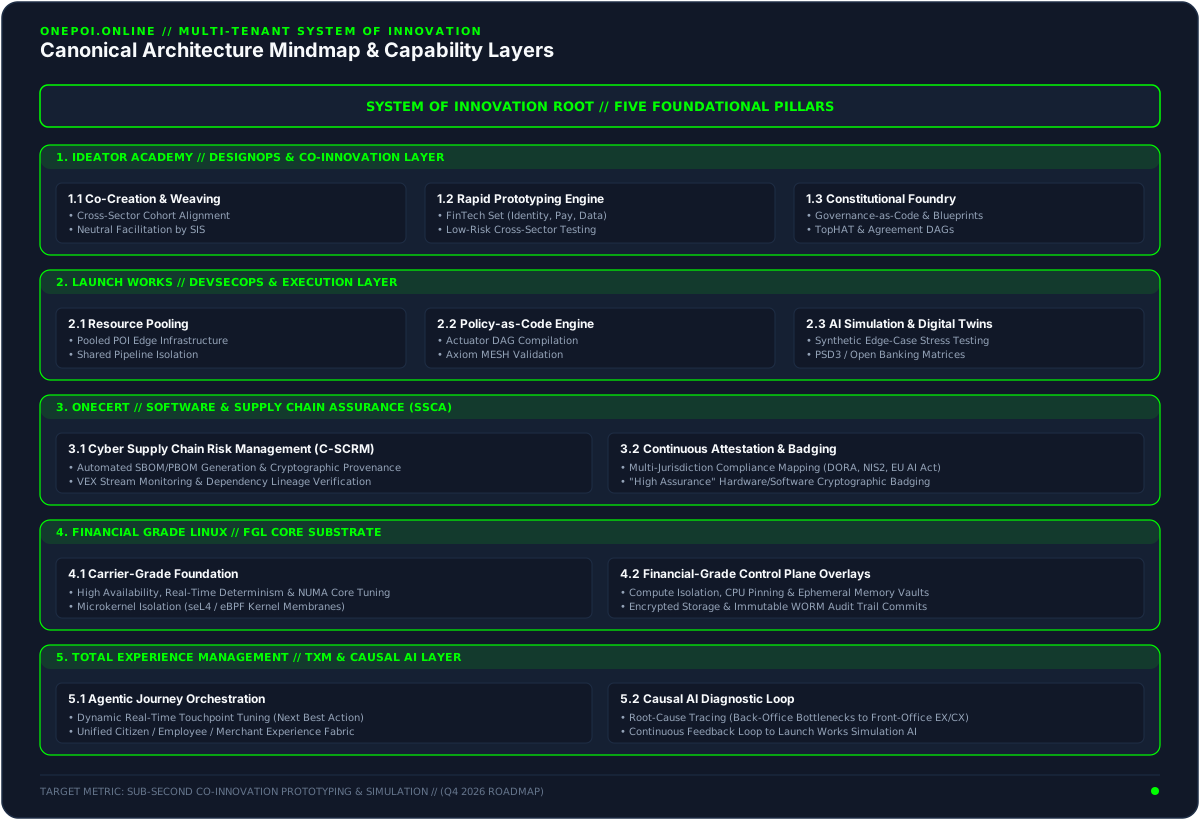
This hierarchical structure maps the technical controls, processes, and boundaries across the five operational layers of the System of Innovation ecosystem:
The onePOI.online Multi-Tenant System of Innovation
Vector Architecture Diagram
Figure: The onePOI.online Multi-Tenant System of Innovation (Target Metric: Sub-Second Co-Innovation Prototyping & Simulation (Q4 2026 Roadmap))
The Ideator Academy Multi-Tenant System of Innovation
Author: Systems Architecture Group · Target Audience: Enterprise Architects, CTOs, CROs, Innovation Leads
Abstract
This paper details the architectural framework of the Ideator Academy, the System of Innovation (SoI) engine within the onePOI.online multi-tenant phygital ecosystem. By combining Gartner’s Pace-Layered Architecture with open innovation resource-pooling models, the Ideator Academy enables cross-sector Tenant Cohorts to design, validate, and launch complex phygital services. We present the end-to-end stack – from DesignOps co-innovation to DevSecOps execution via Launch Works, supply chain verification via oneCERT, deterministic execution on Financial Grade Linux (FGL), and closed-loop optimisation via Total eXperience Management (TXM).
1. Introduction & Context
Modern enterprise digital transformation is frequently constrained by the tension between core operational stability and the demand for market innovation. Traditional R&D models within highly regulated sectors (e.g., Banking, Telecom, Public Sector) suffer from prohibitive capital requirements and long deployment cycles.
The onePOI.online ecosystem resolves this by deploying an open-innovation, multi-tenant framework facilitated by the Salient Innovation Set (SIS). Rather than licensing static software, tenants participate in an orchestrated, resource-pooled ecosystem where shared risks and assets unlock cross-sector capabilities.
2. DesignOps Phase: The Ideator Academy
The Ideator Academy serves as the initial design and prototyping laboratory for Tenant Cohorts.
Ideator Academy DesignOps Flow
01. Cohort Weaving
Aligning complementary tenants (FSI/CSP/Retail) to address market gaps.
02. FinTech Prototyping
Building POCs utilising Agentic Identity, Payments, & Data Exchange.
Cross-Sector Cohort Weaving: SIS acts as a neutral facilitator, aligning complementary tenants (e.g., matching a financial institution with a telco and a retail chain) to address joint market opportunities.
FinTECH Innovation Set Prototyping: Cohorts leverage native platform capabilities – such as Agentic Identity, Agentic Payments, and Agentic Data Exchange – to construct low-risk proofs-of-concept (e.g., automated micro-finance distribution at physical retail kiosks).
The Constitutional Foundry: Operating within the oneCDE.online workspace, multidisciplinary teams author "governance-as-code". Domain experts from TopHAT translate legal and regulatory parameters into machine-readable Axioms and Agreement Directed Acyclic Graphs (DAGs).
3. DevSecOps & Resource Pooling: Launch Works
Once a concept passes initial design validation in the Ideator Academy, it transitions into Launch Works for co-development and industrialisation.
Launch Works & oneCERT Pipeline
Launch Works Engine
Resource Pooling · Policy-as-Code Compilation · AI Twin Simulation
oneCERT Verification
SSCA Continuous Attestation · C-SCRM Risk Audit
Resource & Infrastructure Pooling: Cohorts jointly fund the physical and digital deployment assets, such as POI Appliances and Edge Compute Nodes. This transforms high individual CapEx into a shared OpEx model.
Policy-as-Code Compilation: The Composer compiles natural language legal agreements into a structured, machine-checkable rulebook (Agreement DAG). This rulebook is mathematically validated against the shared Axiom MESH to prevent policy drift before certification.
AI-Driven Digital Twin Simulation: Prior to physical deployment, Launch Works generates digital twins of payment rails, API gateways, and edge nodes. Simulation AI subjects the concept to synthetic stress tests, edge-case network loads, and cross-border regulatory scenarios (e.g., PSD3, GDPR compliance chains).
To ensure end-to-end security and operational integrity, the stack relies on two foundational layers:
A. oneCERT (Software and Supply Chain Assurance)
oneCERT acts as the automated certification gatekeeper. It executes:
Cyber Supply Chain Risk Management (C-SCRM): Generating and verifying Software Bills of Materials (SBOMs) for all cohort assets.
Continuous Attestation: Ensuring every third-party plugin, API connector, and policy module is cryptographically signed and tracked within the Registrar audit ledger before deployment.
B. Financial Grade Linux (FGL)
All services run on FGL, a hardened operating substrate combining Carrier Grade Linux (CGL) reliability (targeting 99.999% availability under the Q4 2026 roadmap, along with live kernel patching) with specialised financial overlays:
Compute Plane: Cryptographic CPU pinning and tenant-isolated execution environments.
Storage Plane: Hardware-encrypted volume segregation and Write-Once-Read-Many (WORM) audit logging.
Network Plane: Deterministic policy-based routing and micro-segmentation at the OS level.
5. Closed-Loop Experience Management: Total eXperience Management (TXM)
The final operational layer is TXM, which links front-stage human experiences with back-stage system performance.
TXM Feedback Loop
Journey Orchestration
Dynamic, real-time touchpoint tuning based on user context.
Causal AI Engine
Traces back-office latency bottlenecks directly to CX/EX anomalies.
Agentic Journey Orchestration: Dynamically adjusts phygital touchpoints in real time based on customer, employee (EX), and partner context.
Causal AI Root-Cause Analysis: Replaces speculative analytics with deterministic causal mapping. If Customer Experience (CX) degrades at a retail kiosk, Causal AI traces the issue through the operational graph – identifying whether the shortfall stems from front-end UX design, an edge node networking latency, or an unoptimised Actuator DAG policy check.
Continuous System Feedback: Causal findings are automatically fed back into the Ideator Academy for refactoring and Launch Works for retrained simulation modeling, completing the self-optimising loop.
6. Hub Application Scenarios
The operational validity of this multi-tenant System of Innovation model applies directly across four real-world hub typologies:
Hub Typology
Primary Open Innovation Model
Academy & Launch Works Implementation
EU Corridor PPP & CivicHUB
Living Lab Testbeds & Quadruple-Helix
Cohorts (Public Sector + Logistics + CSP) co-design smart border and transport corridors. Agreement DAGs enforce cross-jurisdiction data privacy and automated subsidy routing.
Banking HUB
Platform-Based Ecosystems & Secure X-Labs
FSIs and Fintechs pool resources to test PSD3 Open Banking APIs, automated micro-lending, and agentic identity within sandboxed AI digital twins.
Retail HUB
Challenge-Driven Innovation & Living Labs
Retailers and CSPs co-develop frictionless phygital checkout, automated inventory sync, and localised embedded finance at edge POI terminals.
Community HUB
Co-Creation Spaces & Participatory Design
Municipalities and local businesses deploy shared civic kiosks, managing micro-payments, local logistics, and public service access through a unified touchpoint.
7. Conclusion
The Ideator Academy, as the System of Innovation engine for onePOI.online, redefines how competitive enterprises engage in cross-sector co-innovation. By uniting structured DesignOps, pooled DevSecOps execution via Launch Works, continuous software assurance via oneCERT, deterministic execution on Financial Grade Linux, and causal optimisation via TXM, the platform delivers a repeatable, low-risk mechanism for bringing complex phygital concepts to market.
Equip Your Cohort Leadership Team
From €2,500*, a five-day Discovery & Positioning Sprint pairs structured Ideator Academy tracks with your strategic roadmap – giving leadership clarity on Constitutional AI, cohort economics, and implementation fit before committing full programme budgets.
Education, Personal AI & Civic FinOps: EAT ↔ FSI ↔ PSL
Article 165 TFEU • ISCED 0–8 • My Ikigai PKG
1. The Synergy in the Innovation
OpenEMIS + ELM v3.0 + eIDAS 2.0 + My Ikigai
Converges UNESCO ISCED 0–8 lifelong trajectories, OpenEMIS BFT Merkle state roots, and European Learning Model (ELM v3.0) / ESCO skills ontologies with oneWallet.online (OID4VCI/OID4VP), My Ikigai sovereign Personal Knowledge Graphs, Q32.32 CORDIC fixed-point edge determinism across U3 SchoolHUBs, and BIAN v14.0 multi-rail settlement.
Resolves pan-European educator and apprentice mobility under Article 165 TFEU (where Member States retain constitutional subsidiarity over curricula) via STRM Axis 3 ($K \cup R_i$) and Zero-Knowledge Proofs. My Ikigai operates strictly as a private reflective mirror (enforcing The Right NOT to Be Optimised and barring coercive behavioural scoring), while campus A2A payments recycle 150–250 bps of recovered scheme fees into municipal SchoolHUB nutrition and connectivity budgets (target metric – Q4 2026 / 2027 roadmap).
3. The “Aha!” Breakthrough Moment
Portable Capability Without Surveillance
Cross-border credential recognition no longer requires surrendering national curriculum autonomy to a central database. When OpenEMIS state roots, ELM v3.0 micro-credentials, and My Ikigai PKGs verify via zero-knowledge proofs and are funded by SEPA Instant / TIPS (Tier 1) and Faster Payments / FedNow (Tier 2) interchange recycling, lifelong capability travels across 27 Member States while intimate learner reflection never leaves sovereign human control.