From Hallucinatory Vector Silos to Grounded Neuro-Symbolic Ontologies
Modern enterprise AI architectures rely heavily on vector databases and unconstrained probabilistic embeddings for retrieval-augmented generation (RAG). However, statistical similarity metrics cannot distinguish between a legally binding obligation, a discretionary permission, or an explicit statutory prohibition. In high-stakes financial, healthcare, and governmental environments, ungrounded neural outputs create unacceptable compliance drift and catastrophic operational liabilities.
Within the Salient Innovation Set, the KnowledgeHUB establishes the non-negotiable Semantic Pre-Condition for the System of Record (SoR). It provides an authoritative, 30+ graph federated ontology – mapping raw neural vector representations back to formal BIAN v14.0, FIBO, and W3C DID schemas under a Closed-World Assumption (CWA). Only after transaction parameters achieve rigorous ontological verification does the substrate commit the state as a bitemporally pinned Lawful Act Hyperedge (LAHE).
Ungrounded Embeddings & Vocabulary Silos
Legacy systems scatter domain logic across siloed relational tables, schema-less document stores, and black-box vector indices. When autonomous agents reason across multi-party contracts, vocabulary mismatches produce hallucinations, conflicting business definitions, and unprovable audit trails.
Closed-World Ontologies & Bi-Temporal Hypergraphs
KnowledgeHUB unifies 30+ domain knowledge graphs into a single bi-temporal hypergraph network. Every agent proposition is validated against formal TBox taxonomies and deontic axioms, guaranteeing mathematical truth and deterministic reproducibility across historical time ($T_V \otimes T_T$).

KnowledgeHUB Runtime Manifest
SoR // FEDERATED ONTOLOGICAL CONTROL PLANE
Semantic Pre-Conditions, PSD3 / FiDA Conformance & Hallucination Elimination
For Chief Digital Officers, Lead Architects, and Compliance Executives, KnowledgeHUB transforms regulatory integration and AI governance from reactive manual audits into an active, wire-speed verification substrate. By harmonising diverse operational vocabularies into an interoperable semantic fabric, institutions eliminate compliance friction and unlock autonomous cross-domain collaboration.

PSD3 & FiDA Open-Data Harmonisation
Aligns diverse banking, insurance, and investment schemas with BIAN and FIBO canonical standards, guaranteeing instant cross-border API interoperability without costly point-to-point translation layers.
Hallucination Elimination via CWA
Enforces the Closed-World Assumption (CWA) across agent decision flows. If a proposed transaction node or relationship cannot be substantiated by the active ontology, execution is deterministically rejected.
Sub-500µs Ontological Snapping
High-speed SIMD projection maps continuous vector outputs from neural models into discrete symbolic legal nodes in sub-500 microseconds (target metric, Q4 2026 roadmap), enabling real-time neuro-symbolic reasoning.
Unified Phygital World Model
Seamlessly binds physical hardware devices, IoT telemetry, legal entities, and financial instruments into a cohesive graph topology, powering cross-sector autonomous commerce.
The Six Interconnected Knowledge Graph Fabrics
Rather than treating data as flat relational tables, KnowledgeHUB coordinates 30+ specialised sub-graphs grouped into six canonical architectural fabrics to govern all aspects of sovereign interaction.

Party Knowledge Graph (PKG)
Models legal entities, sovereign individuals, autonomous agents, and their delegative relationships. Binds W3C Decentralised Identifiers (DIDs) and eIDAS 2.0 Qualified Electronic Attestation of Attributes (QEAA) to active session authority matrices.
Agreement Knowledge Graph (AKG)
Maintains the canonical legal logic governing multi-lateral contracts. Encodes BIAN v14.0 Agreement Lifecycles, Ricardian smart legal contracts, and deontic rights, duties, and prohibitions across temporal milestones.
Control Flow Graph (CFKG)
Tracks dynamic agent execution paths, state machine transitions, and concurrency constraints. Evaluates parallel agent actions using category-theoretic colimits ($\text{Colim } \mathcal{D}$) to guarantee conflict-free convergence.
Security & Compliance (SKG)
Codifies cyber threat postures, MITRE ATT&CK techniques, NIS2 controls, and DORA ICT supply chain dependencies. Enables instant threat-impact analysis across hardware, software, and vendor ecosystems.

Universal xBOM Mesh
Directly links to the Registrar to maintain recursive component lineages. Couples physical hardware registers (HBOM), software binaries (SBOM), AI model weights (AI/ML-BOM), and data sets (DBOM) into unified Product BOMs.
Product & Value Graph (PVG)
Governs value definitions, pricing schedules, ISO 20022 message mappings, and Digital Product Passports (DPP / ESPR). Powers frictionless commercial settlement and supply chain transparency.
Unified Ontological Memory & Cross-Domain Blast-Radius Traversal
KnowledgeHUB operates as the platform's Unified Semantic Memory, bridging the chasm between commercial financial messaging and low-level cybersecurity telematics. By cross-mapping BIAN v14.0 Service Domains (such as Clearing & Settlement, Payment Execution, and Party Reference) and ISO 20022 schemas with MITRE ATT&CK, MITRE ATLAS (AI threat vectors), D3FEND, R3ACT, and the MAESTRO 7-layer framework, KnowledgeHUB transforms abstract threat telemetry into immediate business intelligence.
Technical Impact
Identifies the exact microservice container namespaces, SmartNIC DPUs, and physical Point of Interaction (POI) kiosk firmware modules exposed to an operational or security anomaly.
Cognitive & Data Lineage
Traces which AI models (AI/ML-BOM) consume the service and which Personal Knowledge Graph (PKG) data products flow through its memory buffers, enforcing Zero-Knowledge isolation.
Contractual & Fiduciary Exposure
Maps the incident directly to active tenant agreements and BIAN arrangements, calculating potential SLA breach liabilities and generating an automated Business Service Management (BSM) Impact Dossier.
Bi-Temporal Hypergraphs, Category Colimits & The Semantic Snapping Pipeline
How KnowledgeHUB turns probabilistic neural embeddings into deterministic, auditable, and mathematically provable state commits.
Lawful Act Hyperedges (LAHE)
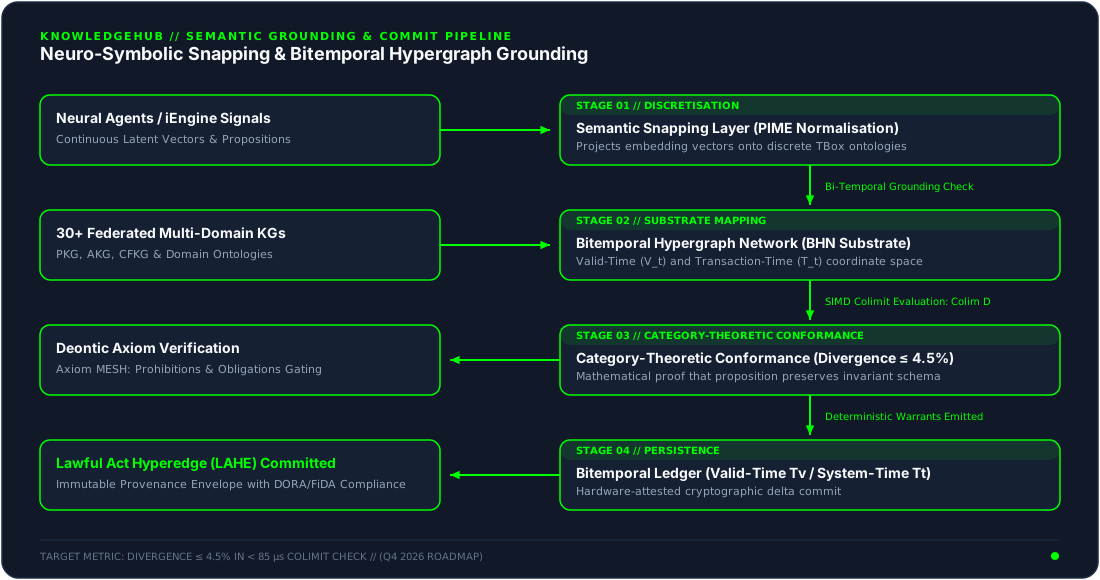
Instead of simple binary relationships ($A \rightarrow B$), KnowledgeHUB commits transactions as multi-dimensional Hyperedges. A single LAHE indivisibly binds Party, Role, Agreement, Resource, and Evidence across Valid-Time ($T_V$) and Transaction-Time ($T_T$).
SIMD Colimit Evaluation ($\text{Colim } \mathcal{D}$)
Parallel agentic workflows are synthesised into a single valid state through category-theoretic colimits. Morphism divergence is strictly bound to $\le 4.5\%$ and temporal skew capped at $\le 150\text{ ms}$ (target metric, Q4 2026 roadmap), preventing conflicting state mutations.

Neuro-Symbolic Snapping
Continuous latent representations emitted by LLMs and foundation models are projected into discrete TBox ontologies. If an agent proposition lacks an explicit ontological mapping, it is instantly trapped and rejected prior to execution.
The Foundational Trust Engine for BIAN Standards & Real-Time Financial Rails
The overarching framework is the Salient Innovation Set, and at its foundational core lies the Salient FinTech Innovation Set. Every phygital, civic, healthcare, retail, or agentic transaction ultimately resolves into a lawful value exchange, identity binding, cryptographic settlement, or fiduciary obligation. KnowledgeHUB provides the non-negotiable semantic trust engine that makes this entire sovereign ecosystem viable for all incoming Tenant Cohorts.

BIAN v14.0 Semantic Architecture
Direct native ontological alignment with Banking Industry Architecture Network (BIAN) Service Domains: Clearing, Settlement, Position Keeping, Party Authentication, and Financial Mandate Lifecycles.
Real-Time A2A & ISO 20022 Rails
High-frequency account-to-account (A2A) rails (SEPA Instant, Faster Payments, FedNow) executing with sub-second finality. KnowledgeHUB validates semantic sanctions, counterparty credentials, and payment mandates prior to instruction dispatch.
Token Gantry & Fiduciary Tokens
Binds cryptographic capability tokens to verifiable knowledge graph nodes, ensuring that assets transferred across tenant boundaries carry unalterable deontic permissions and cryptographic non-repudiation proofs.
Semantic Carbon Ontologies & The Runtime Carbon VETO
Sustainability is deeply woven into the knowledge graph topology. KnowledgeHUB continuously attaches embodied and operational carbon metrics to all computational assets, enabling real-time ESG governance across cloud and edge nodes.
Lifecycle ESG Graph Tagging
Graph nodes for hardware appliances, container workloads, and AI model checkpoints carry certified carbon intensity attributes ($g\text{CO}_2e/\text{kWh}$ and $\text{kgCO}_2e$ embodied), providing real-time ESG auditability for Corporate Sustainability Reporting (CSRD).
The Runtime Carbon VETO
When regional electrical grids experience high fossil-fuel generation spikes, KnowledgeHUB triggers a constitutional Carbon VETO – automatically rescheduling compute-intensive batch graph traversals or model fine-tuning to periods of peak renewable supply.
The 4-Tier STRM Cohort Crosswalk & Tenant Sector Realisation
How incoming Tenant Cohorts progressively deploy and scale KnowledgeHUB across enterprise maturity levels and commercial sectors.
Genesis Anchor Cohort
Pre-launch charter ratification, establishing foundational BIAN and FIBO core ontologies, CapEx pooling, and terms of service binding.
Commercial Bilateral Mesh
Cross-bank semantic API integration, real-time A2A SEPA Instant / Faster Payments settlement graphs, and bilateral Agreement DAG execution.
Multi-Tenant Phygital Network
Shared POI Appliances, LockerSHOP 3PL hubs, concessionaire DAGs, and multi-brand Digital Product Passports under zero-knowledge isolation.
Sovereign Infrastructure
Continuous oneCERT attestation, in-kernel eBPF graph membranes, and cross-jurisdiction treaty federation across international borders.
BIAN Agreement lifecycles, ISO 20022 sanctions screening, real-time A2A account mappings, and Basel IV risk data aggregation.
Concessionaire revenue split DAGs, ESPR Digital Product Passports, LockerSHOP telemetry, and automated merchant margin liberation.
Cross-agency entitlement graphs, citizen sovereign digital identities (eIDAS 2.0 / UK DIATF), and surcharge-free civic disbursements.
EHR privacy-preserving party graphs, farm-to-fork supply chain provenance, and cold-chain IoT attestation commitments.
Summary Matrix: Legacy Graph / RAG Databases vs. Sovereign KnowledgeHUB
How the Sovereign KnowledgeHUB fundamentally transforms enterprise data fidelity, AI grounding, and regulatory compliance.
| Dimension | Legacy Systems (Neo4j, Vector DBs, LangChain RAG) | The Sovereign KnowledgeHUB (Constitutional OS) |
|---|---|---|
| Semantic Grounding | Probabilistic vector distance (cosine similarity) with hallucination risk | Closed-World Assumption (CWA) grounded in formal BIAN/FIBO TBox ontologies |
| Temporal Fidelity | Single timestamp or point-in-time snapshot; history overwritten on update | Dual-axis Bi-Temporal Hypergraphs ($T_V \otimes T_T$) preserving unalterable audit trails |
| Agent Concurrency | Optimistic locking or eventual consistency; prone to race conditions | SIMD Colimit Evaluation ($\text{Colim } \mathcal{D}$) bounding divergence to $\le 4.5\%$ |
| Deontic Governance | Implicit in procedural code; cannot guarantee prohibition dominance | First-Order Deontic Dominance ($\mathbf{F} \succ \mathbf{O} \succ \mathbf{P}$) evaluated inside TEE enclaves |
| Regulatory Assurance | Subjective post-hoc log queries; manual audit reconciliation | Deterministic Lawful Act Hyperedges (LAHE) committed to cryptographic evidence vaults |
| Target Lookup Latency | 10ms – 150ms network API hops across disjoint microservices | < 500 μs in-memory ontological lookup (Target Metric · Q4 2026 Roadmap) |
Category-Theoretic Colimits & Bi-Temporal Interval Algebra
Deep Science: Category-Theoretic Colimits & Commutative Functors
Pushouts, colimit convergence proofs, and morphism divergence bounds
Deep Science: Category-Theoretic Colimits & Commutative Functors
Pushouts, colimit convergence proofs, and morphism divergence bounds
When multiple autonomous agents propose concurrent state modifications to the Phygital World Model, KnowledgeHUB treats each agent's local viewpoint as a small diagram $\mathcal{D}: \mathbf{J} \to \mathbf{OntoGraph}$. The unified global state is computed as the categorical colimit of the diagram:
If the morphism divergence between proposed agent trajectories exceeds the target bound of $\Delta \le 4.5\%$, the colimit evaluator halts automatic resolution and raises a TopHAT human-in-the-loop adjudication request.
Deep Technical: Bi-Temporal Interval Algebra & Hyperedge Pointers
Allen's interval algebra, bitemporal R-Tree indexing, and sub-millisecond query evaluation
Deep Technical: Bi-Temporal Interval Algebra & Hyperedge Pointers
Allen's interval algebra, bitemporal R-Tree indexing, and sub-millisecond query evaluation
Bi-temporal indexing models facts as 2D orthogonal intervals across Valid Time $[t_{val\_s}, t_{val\_e})$ and Transaction Time $[t_{tx\_s}, t_{tx\_e})$. Querying historical legal state at historical transaction coordinate $T_{tx}$ for valid business date $T_{val}$ is executed via spatial R-Tree bounds:
This mathematical model ensures that retroactive contractual corrections or regulatory adjustments never alter past consensus, providing unassailable evidence for judicial and regulatory inquiries.
The Control-Flow Knowledge Graph (CFKG ≡ Meta-CFG), Bitemporal Hypergraph Neural Networks (B-HGNN) & STIX 2.1 Federation
Conventional enterprise knowledge graphs are static noun-graphs: they catalogue passive entities (servers, tables, users) with unitemporal binary edges, remaining structurally blind to how execution control actually flows or how adversarial exploits chain benign operations into "Weird Machine" failures. Inside KnowledgeHUB, the Control-Flow Knowledge Graph (CFKG) and the Meta-Control Flow Graph (Meta-CFG) are structurally identical – embedding executable control flow intrinsically into a dual-axis bitemporal hypergraph containing over ≥ 300 Billion RFC-8141 BOM-Link edges.
Normative Graph
Agreement DAGs and Axiom MESH Hohfeldian deontic rules (\(\mathbf{F} \succ \mathbf{O} \succ \mathbf{P}\)) defining what ought to happen lawfully.
Observed Graph
Inspector in-kernel eBPF/Tetragon syscalls and PTP-timestamped cryptographic Glyphs capturing what actually happened.
Authority Graph
Advanced NIST NGAC Subject/Agent/Object DAGs and On-Behalf-Of (OBO) delegation warrants proving entitlement.
Provenance Graph
The full 9-Category CycloneDX 2.0 xBOM Mesh proving what exact hardware, software, model weights, data, and keys executed.
Causal Graph
Polyadic Lawful Act Hyperedges (LAHEs) and inSight 360 ED-SCGN motifs isolating root cause and liability.
Polyadic Lawful Act Hyperedges (LAHE) & B-HGNN Sandbox Cloning
Rather than flattening multi-party operations into dyadic (\(1:1\)) binary edges, KnowledgeHUB binds identities, roles, the active 9-Category xBOM Master Policy Hash (\(\mathcal{PH}\)), and deontic constraints across Valid Time (\(T_v\)) and Transaction Time (\(T_t\)):
When an autonomous agent proposes a structural change to a service topology, the Bitemporal Hypergraph Neural Network (B-HGNN) clones the active hypergraph segment into an isolated Valid-Time (\(T_v\)) sandbox to forward-simulate liquidity, deadlock, and compliance impacts prior to execution.
STIX 2.1 Bitemporal Hyperedge Normalisation (Zero Tag Explosion)
To unify 17 federated cyber, fraud, AI, and OT threat frameworks without SIEM tag explosion, the Bitemporal Hypergraph Ledger (BHL) normalises all TAXII 2.1 feeds into three polyadic STIX 2.1 hyperedge classes on each CFKG branch:
- 1. stix2:attack-pattern: Simultaneously attaches MITRE ATT&CK (Enterprise/Mobile/ICS), F3 (Fraud), ATLAS (AI), EMB3D (Embedded/POI), FiGHT (5G), DISARM, CAPEC, and OWASP (API / ASI01–10) IDs to a single state transition (\(\Delta S\)).
- 2. stix2:course-of-action: Binds MITRE D3FEND countermeasures, MITRE Engage deception traps, and CRI Cyber Profile (>2,100 regulatory diagnostic controls) to Formal Verification Engine (FVE) verified Conductor / R3ACT Actuator DAGs.
- 3. stix2:intrusion-set & campaign: Clusters multi-branch alerts across the 4 vertices of the Diamond Model (Adversary, Capability, Infrastructure, Victim) and Unified Kill Chain / FS-ISAC phases.
Deontic Dominance, TBox Schemas & Colimit Proofs
Deontic Dominance hierarchy proofs, TBox T-Schema ontologies, and Closed-World Assumption specifications have been compiled into the Salient Innovation Set Deep Tech Series.