
Unifying Logistics, Commerce, and Financial Execution at the Edge
onePOI Bridge (also known as oneBridge) removes the hardware-to-cloud integration bottleneck at the counter and locker edge. Operating as the kinetic integration gateway within the inConcert iPaaS layer of the System of Engagement (SoE), it connects cloud-side business logic cleanly to a shared fleet of Multi-Tenant Point of Interaction (POI) appliances.
By standardising physical hardware interfaces into a unified, network-addressable execution surface, oneBridge transforms traditional edge components into a software-defined "Universal Surface". It allows merchants, financial services institutions (FSIs), and public-sector operators to run complex, multi-tenant workflows safely and simultaneously on the exact same physical footprint without data cross-contamination or infrastructure sprawl.

onePOI Bridge Runtime Manifest
Phygital Hardware Interface
Kinetic Integration and Semantic Normalisation
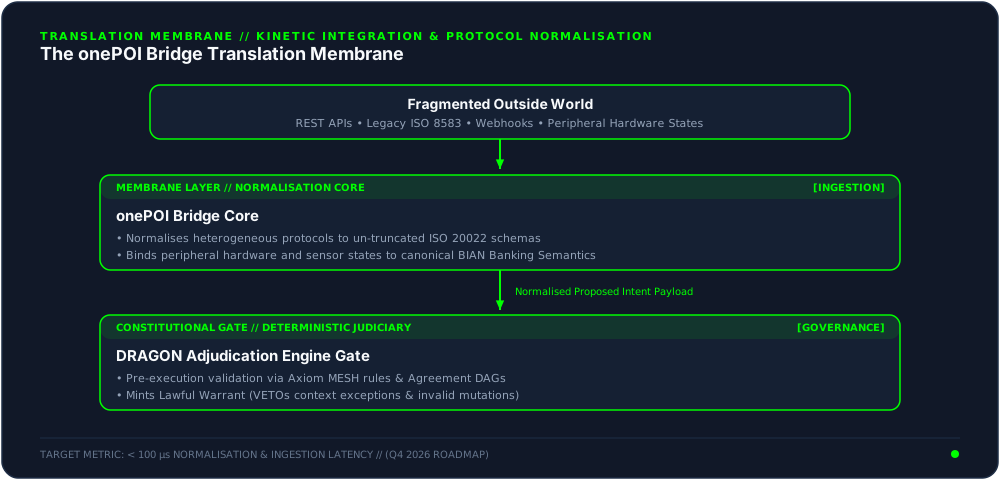
The onePOI Bridge functions as a sophisticated abstraction membrane, absorbing the probabilistic chaos and fragmented dialects of the outside world and normalising them into the deterministic, law-bound execution core of the Constitutional Operating System (COS).
Protocol Normalisation
The bridge converts a highly fragmented matrix of external inputs – including RESTful APIs, legacy ISO 8583 banking card formats, provider-specific webhooks, and raw device parameters – into a unified, internal schema based on untruncated ISO 20022 message extensions.
Event Flow Integrity & Atomic Locks
By standardising hardware peripherals on the modern CEN XFS4IoT protocol, oneBridge treats physical components as network-addressable, containerised microservices. During execution, it enforces Event Flow Integrity, placing a pessimistic Atomic Lock on a peripheral's hardware registers for the exact microsecond window required to validate and sign local state changes.
Infrastructure Legacy Integration & CapEx Preservation
The Bridge enables organisations to salvage their massive legacy hardware estates (ATMs, POS terminals, kiosk enclosures) by retrofitting them with secure, governed digital interfaces. This preserves existing CapEx while unlocking modern phygital services.
It normalises diverse hardware APIs under a single compliant gateway, allowing financial institutions and retailers to satisfy DORA ICT risk requirements without completely replacing their physical assets.

ICT Risk Compliance (DORA)
Provides a secure, audited gateway for older hardware to communicate with cloud cores.

CapEx Lifespan Extension
Allows legacy ATMs and terminals to connect directly to the governed platform network.
Orchestration & Symphony Integration
Operating at the outer boundary of the System of Engagement (SoE), the Bridge translates raw device telemetry into structured, Ontological inputs. It coordinates with the layers of the platform:
BIAN v14.0 Product Orchestration
Snaps raw hardware outputs into standardised BIAN v14.0 product orchestration service domains, executing Employee Agreement DAGs with BRB/ER probabilistic reasoning.
Performance MVEB Validation
Validates hardware actions and operator authority using Performance Minimum Viable Evidence Bundles (MVEBs), eliminating TOCTOU vulnerabilities prior to ledger commitment.
xBOM Registry Sync
Ensures all connected devices are logged in the hardware bill of materials registry.

XFS4IoT Standardisation & Gateway Sidecars
XFS4IoT Standardisation & Gateway Sidecars
XFS4IoT Standardisation & Gateway Sidecars Details
Interfaces with physical peripherals using the XFS4IoT protocol standard. The Bridge deploys secure sidecars on host machines, wrapping device calls in cryptographically verified envelopes and executing syntactic validation before packets leave the local subnet.

Signal Canonicalization & Ontological Mapping Proofs
Signal Canonicalization & Ontological Mapping Proofs
The Bridge executes algebraic signal canonicalization proofs to guarantee that raw sensor telemetry is Snapped into the KnowledgeHUB ontology without semantic data loss, preventing vocabulary collisions or unmapped execution paths.
The Non-Negotiable Financial Trust Engine
The overarching framework is the Salient Innovation Set, with the Salient FinTech Innovation Set at its foundational core. Every phygital, civic, healthcare, retail, or agentic interaction ultimately resolves into a lawful value exchange, identity binding, cryptographic settlement, or fiduciary obligation. The FinTech innovation set provides the non-negotiable trust engine that makes the entire sovereign ecosystem viable for all incoming Tenant Cohorts.

BIAN v14.0 Product Orchestration
onePOI Bridge maps peripheral hardware events and XFS4IoT service calls directly into BIAN v14.0 Product Orchestration Service Domains, providing verifiable attestation chains for physical terminals, cash dispensers, and multi-tenant financial services.

Real-Time A2A Rails & Settlement
Enables wire-speed bridging between local merchant hardware and sovereign Account-to-Account rails (SEPA Instant, Faster Payments, FedNow), eliminating legacy intermediary terminal processor fees and batch latency.

Token Gantry Value Custody
Confidential enclave tunnels between edge appliances and the Token Gantry prevent physical tampering, bus interception, or side-channel leakage of session encryption keys and payment tokens.
BRB/ER Employee DAGs & Performance MVEBs
Embeds Evidential Reasoning (ER) and Belief Rule Base (BRB) nodes into Employee Agreement DAGs, mathematically fusing multi-modal evidence into unified belief distributions and Glyphic Verdicts. Emits Performance Minimum Viable Evidence Bundles (MVEBs) that eliminate TOCTOU vulnerabilities with replayable proof chains.
Constitutional Cyber-Physical Governance Across Smart Peripherals, Edge MEC & Autonomous Robotics
Under Stage H (v8.2) of the Canonical Architecture, onePOI Bridge extends beyond commercial payment terminals into the unified hardware-software nervous system for the entire phygital and cyber-physical edge. Whether orchestrating XFS4IoT smart peripherals at retail checkout (Merchant ONE), Private 5G to 6G Multi-Access Edge Compute (MEC) micro-clouds, or autonomous mobile robots (AMRs), UAV drones, and surgical/industrial actuators, every physical bus command is governed by the same deterministic constitutional fabric.
Zero Cleartext Residence at the Edge
Sensitive biometric, EMV, NFC, and telemetry payloads undergo Earliest-POI Tokenisation inside the hardware enclave at the exact millisecond of physical sensor capture. Paired with Wipe-Attested Storage (WAS) and Just-in-Time (JIT) KeyMESH ephemeral key injection via oneVault Mesh, peripheral memory leaves zero residual cleartext state after transaction completion.
Wire-Speed Actuator Interception
For autonomous robotics and IIoT fleets, kernel-level eBPF filters intercept ROS 2 DDS, CAN-FD, and EtherCAT actuator buses for adjudication by the DRAGON Gatekeeper ASIC in under 45µs (target metric – Q4 2026 / 2027 roadmap). The kinetic dominance law enforces $\mathbf{F}_{\text{Kinetic-Safety}}(\text{LiDAR Human Proximity} \lor \text{Torque Limit} \lor \text{Geofence}) \succ \mathbf{O}_{\text{Task}}(\text{Path}) \succ \mathbf{P}_{\text{Explore}}(\text{Trajectory})$.
Phygital Machine Commerce
Multi-robot logistics swarms, EV V2G chargers, and automated smart-factory cells coordinate multi-party physical tasks via cryptographically signed Swarm Agreement DAGs compiled in oneCDE.online. Every physical actuator milestone triggers atomic machine-to-machine (M2M) micro-settlement and parametric insurance binding across Switcher+ and BIAN v14.0 settlement domains.
The Synergy in the Innovation: Unifying XFS4IoT financial terminal orchestration, Private 5G to 6G MEC edge appliances, and ROS 2 / CAN-FD robotic actuator governance under one hardware-enforced deontic bus. The Innovation in the Synergy: Treating a robotic torque command and a high-value payment authorisation as isomorphic state transitions subject to the exact same $\mathbf{F} \succ \mathbf{O} \succ \mathbf{P}$ hardware veto. The “Aha!” Breakthrough: Physical machines can neither violate human kinetic safety envelopes nor execute unauthorised economic commitments, turning every edge peripheral and autonomous robot into a constitutionally accountable economic actor.
Warrant-Gated Cyber-Physical Actuation & Stage H Tier 4 Clinical Robotics Mediation
Under the STRM Axis 1 Crosswalk, onePOI Bridge (elem-comp-onepoi-bridge) is proved to be a strict mathematical SUPERSET_OF LACE Service 5 (Capability-Gated Action Mediation, elem-lace-srv-5) while remaining strictly DISJOINT ($A \perp B$) from iEngine probabilistic inference. In the HAP ⟷ CTC Cross-Sector Seam (SEAM-2026-10-22-03), onePOI Bridge mediates surgical and pharmacy cold-chain robotics over Private 5G MEC at 100Hz to 1kHz control rates (target metric – Q4 2026 / 2027 roadmap), guaranteeing that no physical actuator can move without a co-signed DRAGON warrant.