Hardware-Isolated Custody for Tenants and Citizens Alike
oneVault Mesh functions as a distributed fleet of hardware safety deposit boxes – keeping each tenant's signing keys and each citizen's verified credentials (identity documents, health claims, payment tokens) encrypted inside their own isolated boundary.
Even on a shared appliance or pooled cohort node, no other institution – and no platform administrator – can inspect sealed records without an explicit, time-bounded cryptographic warrant.
oneVault Runtime Manifest
Sovereign Credential Vault
Sovereign Data Storage & Customer Data Ownership
oneVault Mesh mitigates the risk of corporate data breaches by decentralising customer data storage. It allows users to store credentials in cryptographically isolated vaults.
This satisfies eIDAS 2.0 electronic wallet security rules, protecting enterprise clients from the massive liabilities associated with central database compromises.

eIDAS 2.0 Wallet Security
Aligns vault security with the high-assurance standards required for EUDI wallets.
Data Breach Risk Minimisation
Eliminates centralised database targets, protecting customer records from mass leaks.
Orchestration & Symphony Integration
As the secure memory space in the System of Record (SoR), the Vault Mesh anchors private credentials. It coordinates with the platform layers:
Vault Binding
Binds vault access to the user's sovereign Digital Twin of the Person (DToP).
Attribute Release
Releases requested attributes only after validating the DRAGON-issued Lawful Warrant.
Lineage Check
Logs vault access histories in bitemporal ledgers for audit tracking.

Hardware Key Isolation & Ephemeral Decryption
Hardware Key Isolation & Ephemeral Decryption
Hardware Key Isolation & Ephemeral Decryption Details
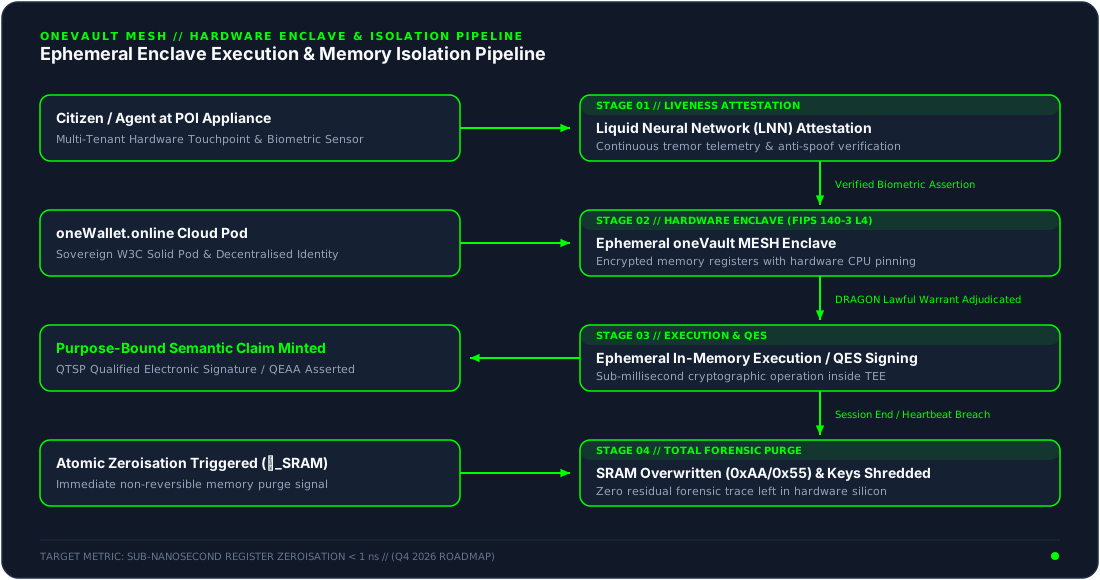
Stores keys within secure enclaves (TEE hardware HSMs). When attribute release is authorised, data is decrypted ephemerally in memory, zeroing out memory regions immediately after transmission.
Sovereign Silicon Enclaves, Active Tamper Zeroization & Multi-Tenant Memory Curtaining
oneVault Mesh enforces strict physical and cryptographic tenant isolation across pooled edge and cloud infrastructure. By pairing FIPS 140-3 Level 4 hardware root-of-trust, AMD SEV-SNP confidential computing enclaves, and sub-millisecond bus-impedance sensing, it guarantees that private keys, credentials, and Zero-Party Data (ZPD) states are physically non-extractable and ephemerally shredded upon session completion.
SRAM HIVE & UCIe 2.0 Slicing
Physical memory addresses are compartmentalised across hardware chiplet fabrics. Tenant enclaves execute in zero-trust isolation with encrypted address buses, preventing Spectre, Meltdown, and Rowhammer side-channel bleed across shared compute appliances.
Dynamic Bus-Impedance Sensing
Micro-electrical heartbeats monitor motherboard traces. Any physical probe attachment or chassis breach shifts bus capacitance, triggering an immediate Authority Collapse: battery-backed SRAM key zeroization and eBPF wire-speed interface severance.
Proximity Vector (\(\vec{P}_v\)) & Amnesiac Edge
Edge POI terminals instantiate the user's oneWallet.online Pod credentials ephemerally. When continuous proximity vector \(\vec{P}_v\) degrades below threshold, registers undergo atomic zeroization (\(\mathbb{Z}_{SRAM}\)), leaving zero forensic residue.
Ecosystem Root of Trust Alignment
oneVault Mesh operates in closed-loop synergy with KeyMESH for post-quantum key rotation, DRAGON Engine for Triadic Lawful Warrant issuance, and oneWallet.online for sovereign Zero-Party Data (ZPD) governance across all commercial and civic touchpoints.
Shamir Secret Sharing & Key Shredding
Shamir Secret Sharing polynomials, TEE enclave memory isolation, and Ephemeral Key Shredding specifications have been compiled into the Deep Tech Series.
The Non-Negotiable Financial Trust Engine
The overarching framework is the Salient Innovation Set, with the Salient FinTech Innovation Set at its foundational core. Every phygital, civic, healthcare, retail, or agentic interaction ultimately resolves into a lawful value exchange, identity binding, cryptographic settlement, or fiduciary obligation. The FinTech innovation set provides the non-negotiable trust engine that makes the entire sovereign ecosystem viable for all incoming Tenant Cohorts.
BIAN v14.0 Substrate Alignment
oneVault Mesh implements cryptographic key virtualization and vault partitions matching BIAN Cryptographic Services and Position Keeping Service Domains for multi-tenant financial institutions.

Real-Time A2A Rails & Settlement
Provides microsecond-level hardware key material injection for signing high-throughput Account-to-Account payment batches across SEPA Instant, Faster Payments, and FedNow.
Token Gantry Value Custody
Hardware-isolated confidential storage ensures that Token Gantry secrets, private payment keys, and customer verification tokens remain tamper-evident across physical and cloud enclaves.
Silicon Apartments, The 5-Tier Confidential Computing Stack & The Revocation Lag Doctrine
In the Stage H (v8.2) Constitutional AI/ML & Cyber-Physical Continuum, oneVault Mesh eliminates the historical trade-off between cloud elasticity and sovereign on-premise custody. By orchestrating hardware-enforced Silicon Apartments across heterogeneous Trusted Execution Environments (TEEs), Tier 1 to 2 bank mainframes, air-gapped sovereign data centres, hyperscale clouds, and Private 5G to 6G MEC edge nodes collaborate on federated AI inference and BIAN v14.0 notional liquidity pooling with zero raw data egress.
Cross-Silicon Cryptographic Isolation
Workloads minted in oneCDE.online execute inside attested memory enclaves spanning AMD SEV-SNP, Intel TDX, ARM CCA Realms, and AWS Nitro Enclaves. Hypervisors, cloud administrators, and host operating systems are mathematically excluded from inspecting tenant model weights, cryptographic keys, or customer PII.
From COTS eBPF to Custom Silicon
The canonical architecture enforces a deterministic four-stage hardware maturity trajectory: Stage 1 COTS Software + eBPF kernel interception; Stage 2 DPU / SmartNIC + Confidential TEE offload; Stage 3 FPGA Wire-Speed Validation; and Stage 4 Custom DRAGON Gatekeeper Silicon achieving sub-45µs adjudication (target metric – Q4 2026 / 2027 roadmap).
Zero-Latency Warrant Termination
Conventional PKI certificate revocation lists suffer from multi-minute propagation delays that autonomous agents could exploit. Through the Revocation Lag Doctrine and the Trust, Risk & Security Management Substrate (TRS-MS), a single missed 100Hz cATO heartbeat (target metric – Q4 2026 / 2027 roadmap) or policy breach triggers instantaneous ephemeral key zeroisation across onePOI Bridge and cloud enclaves.
The Synergy in the Innovation: Combining heterogeneous TEE Silicon Apartments (SEV-SNP, TDX, ARM CCA) with 100Hz cATO cryptographic heartbeats and ephemeral JIT KeyMESH custody. The Innovation in the Synergy: Eliminating the Revocation Lag window by tying operational decryption keys directly to continuous hardware attestation rather than static credentials. The “Aha!” Breakthrough: Regulated institutions can run shared AI models and real-time multi-bank treasury sweeps across untrusted public clouds and edge appliances with mathematical certainty that revocation is instantaneous and raw data never leaves its sovereign vault boundary.
Sovereign AI Compute Spot Market across Federated Retail & Telco Edge Silicon Apartments
Under the STRM Axis 1 & Axis 2 Crosswalk, oneVault Mesh (elem-comp-onevault-mesh) binds 5-Tier Confidential Computing Silicon Apartments (UCIe 2.0 hardware memory isolation) to BIAN v14.0 SD-CEF-26 (Compute & Energy Spot Financing Exchange, elem-bian-pbc-6). In the CTC ⟷ RAH Cross-Sector Seam (SEAM-2026-10-22-06), high-street retail POI Appliances safely lease off-peak NPU/TEE capacity to telco and enterprise AI inference workloads with mathematical tenant disjointness ($T_{\text{Retail}} \cap T_{\text{Guest}} = \emptyset$) and cryptographic post-job zeroisation.
oneVault and Pulumi ESC: Where Centralised Secrets Management Ends and Hardware Cryptographic Custody Begins
Grounded in the flagship position paper oneVault and Pulumi ESC: Two Planes, One Boundary, oneVault Mesh (elem-comp-onevault-mesh, Ranked #16 Infomap Gatekeeper) defines the single most valuable architectural line in the platform: the boundary between Orchestration-Plane Secret Brokering (Pulumi ESC) and Record-Plane Hardware Custody (oneVault).
Pulumi ESC Environment & Secret Brokering
Operating within the System of Orchestration, Pulumi ESC replaces seven or eight fragmented enterprise secret stores with one declarative control plane. It resolves multi-cloud environments, brokers workload identity, and abstracts native cloud credentials so that zero long-lived secrets are ever written into infrastructure code.
The Attenuated On-Behalf-Of (OBO) Token
Pulumi ESC and oneVault meet at exactly one cryptographic artefact: the short-lived, scope-attenuated On-Behalf-Of (OBO) token. Pulumi ESC never touches raw tenant custody keys; it issues the OBO token that authorises a workload to request an in-enclave cryptographic operation from oneVault.
oneVault Volatile Enclaves & Zeroisation
Operating within the System of Record, oneVault receives key fragments inside a hardware-isolated Silicon Apartment, performs the cryptographic operation strictly in volatile enclave memory, and executes immediate Crypto-Shredding with a Notary-signed destruction receipt the instant the customer walks away.
Because credentials exist at the edge only for the duration of a single physically bound interaction before hardware erasure, there is nothing left at the kiosk or checkout to steal. Furthermore, when backhaul connectivity drops, offline edge resilience paths operate independently of the hosted brokerage layer, giving EU DORA supervisors an explicit, testable exit and resilience boundary.
Custodial Enclave Physics – MMU PKEY Silicon Apartments, No-Bus SRAM Hives, Kali RAS, & 120 ps Zero-Residual Teardown
Under EN 18286:2026 Clause 8 (Stage 5: Controlled Withdrawal), EU AI Act Article 10 (Data Retention) & Article 15 (Cybersecurity), and ISO/IEC 27002:2022 Controls 7.14, 8.10, & 8.24, multi-tenant cloud and phygital Point-of-Interaction (POI) edge appliances must prevent cross-tenant memory side channels while proving that ephemeral keys, neural weights, and zero-party data leave zero electrical residue upon session exit or tamper detection. oneVault MESH and KeyMESH JIT enforce custodial isolation and sub-software sanitization at the silicon trace level:
MMU PKEY Silicon Apartments & No-Bus SRAM Hives
Workloads execute inside hardware Trusted Execution Environments (ARM CCA, Intel TDX, AMD SEV-SNP) reinforced at the Memory Management Unit (MMU) by hardware Memory Protection Keys (PKEYs) and Reverse Map Tables (RMP). Pinning each tenant’s compiled Agreement DAG to a dedicated No-Bus SRAM Hive eliminates shared bus traversal, cache-timing side channels, and hypervisor escapes – amortising multi-tenant infrastructure CapEx by up to 70%.
KeyMESH JIT & Kali RAS Ephemeral OBO Tokens
KeyMESH JIT eliminates static user-space secret vaults by assembling dynamic keys on demand inside TEEs and FIPS 140-3 Level 4 HSMs via Remote Key Injection (RKI). Before granting elevated privileges, Kali Remote Attestation Services (Kali RAS) challenges measured-boot eFuses and 4D xBOM Passports, issuing single-use Ephemeral On-Behalf-Of (OBO) tokens that self-destruct upon task completion.
120 ps RCU Swaps, PVIC Flush, & WAS Tokens
Upon session exit, GDPR erasure, or tamper trip: (1) lock-free hardware Read-Copy-Update (RCU) monostable pulses sever SRAM Hive pointer references in 120 picoseconds; (2) Physical Voltage & Charge Interdiction Controllers (PVIC) fire nanosecond pull-high breakers to flush bitline charge down to thermal noise; and (3) the Hardware Root of Trust commits a signed Wipe Attestation Signature (WAS) token to the ledger.