 Merchant +ONE – The Commercial Edge Membrane
The 4-Phase GTM & Implementation Blueprint
A phased deployment sequence for rapid onboarding, instant A2A settlement, and continuous customer retention across phygital retail footprints.
Zero-Friction Edge Upgrades
Deploy the physical Merchant +ONE point-of-interaction (POI) terminal alongside legacy card terminals in high-volume accounts as an alternative, "Sovereign Fast-Pass" checkout lane.
Cryptographic Activation
Customers authenticate via a simple biometric handshake using their mobile EUDI Wallet or oneWallet.online client. The terminal parses eIDAS 2.0 credentials instantly at the silicon edge.
Direct A2A Settlement
The terminal triggers an instant, account-to-account transfer settled in seconds instead of days, liquidating interchange fees and eliminating chargeback risks.
Open Loyalty Lock-In
Every transaction automatically creates a secure, CADA Level 4 compliant Provenance Envelope, unlocking instant merchant rewards and sovereign loyalty cashback.
The Operational Hinge: Arrangement Instantiation
In standard BIAN nomenclature, an Arrangement is a stateful construct representing how a product's terms are parameterised for a specific customer instance. Within the onePOI.online substrate, an Agreement DAG defines abstract behaviour rules, while the Arrangement serves as the centrifugal operational binding node inside the KnowledgeHUB graph.
When a merchant accepts the Merchant +ONE package, the contract is ratified via their sovereign EUDI Wallet. The Arrangement Management PBC instantiates the unique arrangement for each discrete product in the bundle (card acquiring, business current account, POI Appliance hardware lease). Authority flows downward cryptographically: an Actuator DAG in the System of Orchestration (SoO) can only execute what its governing Agreement DAG warrants.
Merchant +ONE Complete Lifecycle Deep Dive
Tracking an enterprise commercial onboarding and transaction string across the Symphony of Systems under EU regulatory mandates (DORA, eIDAS 2.0, PSD3, AMLR).
Dynamic Bundling & Compliance Compilation (The Legislative Foundry)
Product Architects design the Merchant +ONE package inside oneCDE.online, synthesising card acquiring, SME BaaS accounts, SEPA Instant payout rails, and POI Appliance leases into RateCard DAGs.
Before publishing, the CDE's Formal Verification Engine (FVE) executes a Legal Compile using formal solver hardware verification engine to prove Bisimulation – perfect state-machine equivalence between natural legal text and binary execution parameters. If any operational clause violates an L3 Axiom, compilation fails with an UNSAT result, halting non-compliant code at design-time.
Hyper-Personalisation & Computational Offer Management (The Mind)
A corporate executive opens the BIAN-compliant Customer Workbench and presents their EUDI SME Wallet. The Notary Identity Agent performs an instant cryptographic handshake, absorbing verified LEIs into the Party Knowledge Graph (PKG) to establish a Digital Twin of the Person (DToP) anchor.
The Payment Routing Optimiser ingests live processing telemetry mobilised as isolated Zero-Party Data (ZPD), designing a hyper-personalised rate card proposal passed to the System of Agreement as a de-privileged Proposed Intent Payload.
Triadic Adjudication & Contract Ratification (The Hardware-Enforced Policy Adjudicator)
The proposal payload hits the DRAGON Adjudication Engine, executing a 100-microsecond triadic pass (near-term target state architecture, Q4 2026 roadmap):
- Syntactic Pass Aligns data schema with ISO 20022 and GraphQL to prevent execution flaws.
- Semantic Pass Grounds terms strictly in KnowledgeHUB BIAN/FIBO definitions to stop hallucination.
- Pragmatic Pass Verifies real-world context, GPS, latency, and HBOM hardware attestations.
DRAGON applies a Jurisdictional Namespace Overlay, merging regional UK FCA Consumer Duty and EU PSR SCA limits under Canonical Dominance (\(\mathbf{F} \succ \mathbf{O} \succ \mathbf{P}\)). Upon QES signature, an Agreement DAG (ADAG) is cryptographically locked into the ledger.
Streamlined Onboarding & Automated Provisioning (The Executive Hand)
The Workflow Conductor Agent (SoO) deploys parallel Actuator DAG Runbooks via inConcert iPaaS, completing KYB identity locking, multi-currency ledger instantiation, MID clearing switch activation, and POI Appliance firmware image building in sub-minute intervals.
Production Service Operations & Edge Isolation (The Physics)
The POI Appliance splits processing into hardware-isolated TEE Hardware-Isolated Enclaves via an seL4 microkernel. Payment applications, loyalty modules, and transit pass keys co-host safely as eBPF network gates inspect packets at wire-speed based on live xBOM signatures. Transactions log as Lawful Act Hyperedges (LAHE) on a dual-axis Bi-Temporal Ledger, enabling instant Recomputation-as-a-Service (RaaS) audits.
Navigating the Gödelian Shadow (The Human-Agent Loop)
If conflicting regulatory mandates create an un-computable logical paradox (a Gödelian Shadow where hardware verification engine return UNKNOWN), the platform's Fail-Closed Invariant triggers instantly.
DRAGON issues a Systemic VETO to isolate ledger writes. The Guardian Agent seals context into an encrypted Minimum Viable Evidence Bundle (MVEB) and routes it to the human TopHAT Council. Human risk officers sign a biometric Verdict Artifact, which the System of Intelligence ingests to refine policy stencils – closing the Governance Flywheel without rewriting codebase logic.
 ArchiMate 3.2 Aligned Sequence Views & BIAN v14 Lifecycles
Domain: Merchant +ONE & BIAN Substrate
Architecture: Autonomous Agent Crews & Agreement DAGs
ArchiMate 3.2 Aligned Sequence Views & BIAN v14 Lifecycles
Domain: Merchant +ONE & BIAN Substrate
Architecture: Autonomous Agent Crews & Agreement DAGs
Merchant +ONE ArchiMate Sequence Views
Merchant +ONE is modelled as a multi-capability product bundle combining merchant acquiring, business banking, identity, payments, agreement, servicing, device estate, loyalty, trade finance, claims/insurance, and evidence. Its governing architecture synchronises three interdependent lifecycles through the Agreement DAG.
The Correlation Triad: Governing Lifecycles
Prospect → Identified → Verified → Active → Dormant → Exited. Bound to verified Legal Entity Identifiers (LEI) and eIDAS 2.0 digital credentials.
Design → Catalogue → Bundle → Deploy → Manage In-Life → Withdraw. Dynamic assembly of acquiring, terminal hardware, and liquidity facilities.
Propose → Negotiate → Execute → In-Force → Amend → Discharge. The Agreement DAG serves as the central junction object binding rights, limits, and evidence obligations.
Archetype Catalogue: Agent Crews & Authority Artefacts
The Merchant +ONE operational fabric replaces disconnected manual roles with four specialised Autonomous Agent Crews acting within mathematically bounded Action Spaces:

Coordinates need analysis, bundle offer presentment, eIDAS 2.0 KYC/KYB identity verification, and initial Agreement DAG signing.

Manages real-time A2A payment routing, revenue share axiom execution, trade-data underwriting, and deferred batch FX clearing.

Assures POI Appliance HBOM attestation, local LSRG rule caching, Cilium eBPF network isolation, and PAIF cryptographic key shredding.

Automatically triggers parametric SLA payouts, retrieves bitemporal MVEB evidence trails, and escalates edge paradoxes to the human TopHAT Council.
The 6 Sequence Views: From Offer to Governed Exit
Product Discovery, Bundle & Agreement Formation
The Merchant CFO engages the Customer Workbench. The Merchant Steward Crew queries the BIAN Product Directory, evaluates the merchant’s sector profile, and dynamically composes a bundle assembling card acquiring, POI Appliance lease, and trade credit. The Composer compiles the offer into an Agreement DAG containing hardcoded Revenue_Share_Axioms, signed via eIDAS 2.0 QES.
Merchant, People, Device & Agent Onboarding
The Registrar issues sovereign tenant partition IDs. The Device & Edge Crew executes TPM/TEE cryptographic hardware attestation on the POI Appliance, provisions seL4 microkernel enclaves, and pushes Cilium eBPF network isolation rules. Local Legal-State Reachability Graphs (LSRG) are pre-cached for offline resilience.
Phygital Payment & Acquiring Fulfilment
A retail customer scans a QR or taps an NFC token at the POI Appliance. The transaction is validated in sub-50µs target policy cycles by the DRAGON Engine. Instant A2A SEPA settlement executes, or deferred local edge-ledger authorisation logs for sub-€50 baskets. An immutable MVEB evidence bundle is minted and metered via Submission Tokens.
Purpose-Assigned Inventory Finance
The merchant issues a supply order. The Trade-Data Credit Singularity analyses live POS velocity and stock turnover without manual loan applications. The FSI Anchor underwrites working capital instantly, disbursing funds directly into supplier escrow with automated repayment sweeps deducted from daily POS receipts.
Parametric Claim & Human Escalation
If a physical terminal hardware fault or network outage occurs, the Dispute & Claim Crew detects the SLA breach via automated telemetry and triggers an instant parametric insurance indemnity payout. Any edge dispute or logical ambiguity is sealed into an MVEB and routed to the human TopHAT Council for final discretionary adjudication.
Servicing, Renewal & Governed Exit
Continuous FMCMM Level 6 telemetry audits operational performance. In-life contract amendments are compiled directly into live Agreement DAGs. Upon facility termination, PAIF cryptographic shredding securely destroys PII decryption keys, proving GDPR right to erasure while preserving anonymous bitemporal compliance lineage.

The Governance Flywheel in Action
By structuring Merchant +ONE as an ArchiMate-aligned, BIAN-mapped composition, every operational interaction produces forensic evidence by construction. This shifts financial and commercial risk from probabilistic, post-hoc audits to mathematically verified, pre-execution runtime guarantees – giving merchant enterprises an unassailable operational advantage.
Merchant +ONE: From Transaction Endpoint to Economic Node
Independent retailers should not be forced to become technology companies to survive. Merchant +ONE provides a progressive 9-level capability ladder – beginning with simple transaction visibility, scaling to working-capital finance and communal buying, and culminating in hosting critical community infrastructure.
Payments & Settlement
Next-gen POS, instant A2A rails, card acquiring, and cash reconciliation. The merchant becomes digitally and operationally visible.
Unified Telemetry
Connect sales, stock, suppliers, and cashflow data. Stock turns and demand patterns become transparent in real time.
Demand-Led Reordering
Automated stock balancing proposals. Act before stock-outs occur, reducing dead capital in excess backroom inventory.
Evidence-Based Credit
Permissioned operating evidence replaces historic tax returns. Lenders evaluate verified real-time trade activity for instant working capital.
Collective Buying
Join voluntary merchant purchasing consortiums for wholesale volume discounts while retaining independent pricing and ownership.
3PL & LockerShop
Host secure click-and-collect lockers and reverse logistics bays. The retail footprint becomes an active neighbourhood parcel node.
Supply Corridors
Integrate into regional and EU trade corridors. Local merchant demand connects directly to freight consolidation and scheduled freight routes.
Cohort Capital
Participate in syndicated credit structures and liquidity facilities previously available only to multi-national retail chains.
Civic & Commercial Anchor
Host authorised banking, postal, healthcare, or municipal services, earning recurring footfall and sovereign commission yields.
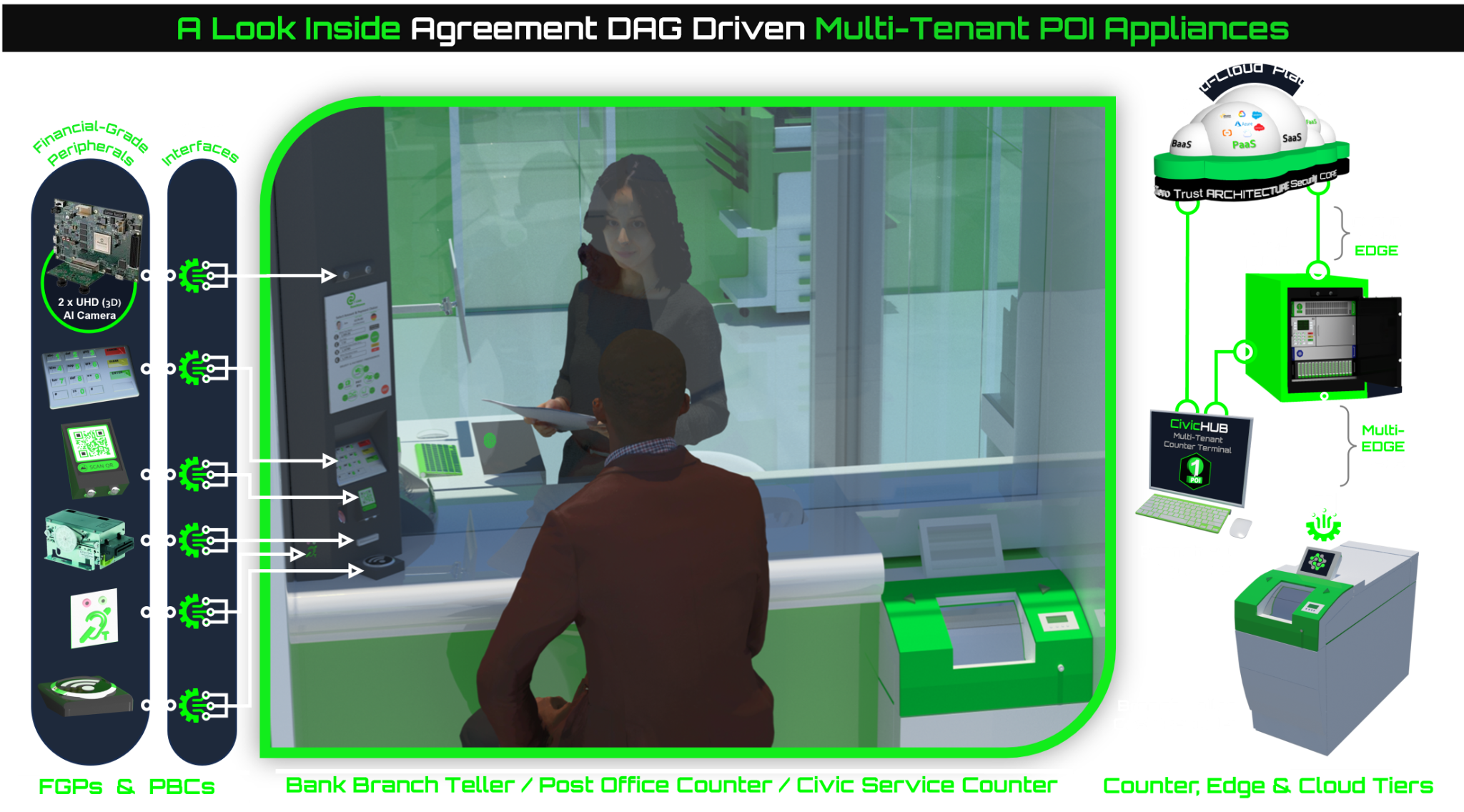
Assisted merchant counters connect financial-grade peripherals through PBC interfaces – enabling independent shops to handle secure bill payments, cash deposits, and verified transactions with banking-grade assurance.

The Human Path is First-Class: Digital capability is reinforced with a dignified human escalation path. Merchant staff are assisted by AI guidance, but never subordinated to unexplainable black-box algorithms.
Strategic Alignment Mapping
Direct comparison between legacy retail infrastructure and the augmented Merchant +ONE subsystem.
| Metric / Objective | Legacy Retail Infrastructure | Merchant +ONE Subsystem |
|---|---|---|
| Transaction Fee Structure | 2.0% – 3.5% lost to traditional card schemes. | Fractions of a penny via instant multi-rail Open Banking APIs. |
| Settlement Velocity | Multi-day settlement delays causing cash-flow drag. | Sub-minute real-time liquidity sweeps and clearing. |
| Compliance Posture | Reactive, manual auditing; high vulnerability to PSD3 fraud shifts. | Proactive, fail-closed "Hardware-Enforced Policy Adjudicator" dropping fraudulent packets via eBPF network gates. |
| Data Architecture | Highly fragmented customer data siloes. | Unified, graph-native operational continuum using BIAN v13 and FIBO ontologies. |
The Salient Innovation Set: FinTech Core Unity
Every merchant checkout, parcel locker access, healthcare interaction, or retail exchange across the onePOI ecosystem ultimately resolves into a lawful value exchange, identity binding, cryptographic settlement, or fiduciary obligation. The Salient FinTech Innovation Set provides the foundational trust engine that makes sovereign multi-tenant operations viable across all physical and digital touchpoints.
Executes BIAN Packaged Business Capabilities (PBCs) directly inside hardware-isolated enclaves, removing middleware latency and ensuring strict semantic compliance.
Native support for SEPA Instant, FedNow, and sovereign account-to-account (A2A) rails guarantees sub-second cryptographic settlement without clearing-house friction.
Hardware-anchored tokenisation transforms credentials, custody tokens, and tender into ephemeral, single-use cryptographic proofs protected against replay attacks.
Immutable record-keeping tracking both system time and valid legal time, enabling mathematically verified audit trails and forensic reproducibility across jurisdictions.
The Power of Guarantees
“We do not sell features. We sell guarantees. By moving from interpretive compliance to automated, deterministic verification, Merchant +ONE provides your enterprise with a non-commoditised moat anchored in cryptographic absolute safety, capital protection, and sovereign trust.”
Seven Ranked Foundational Innovations
How the foundational authority hierarchy transforms retail footprints from commoditised payment points into sovereign, high-margin community banking hubs.
Authority Lives in the Agreement
Authority lives in the agreement, not in the identity. In legacy retail, merchant terminals rely on cardholder identity assertions that generate rampant chargeback fraud. In Merchant +ONE, authority check is the transaction itself – eliminating chargeback disputes at the root.
Unlawful Execution is Unavailable
Unlawful execution is a state the platform cannot enter. The commercial word is insurable. Because compliance rules are pre-compiled into silicon-enforced enclaves, underwriters can formally insure retail automated workflows, stock financing, and instant payouts.
Constitutional Delegation & Agent Liability
Autonomous AI procurement agents order inventory and settle invoices using signed On-Behalf-Of (OBO) delegation tokens with single-action expiry and hard financial caps. If an agent hallucinates, execution halts at the GateKeeper before state mutation occurs.
Lawful Execution at the Counter
Pre-execution adjudication runs locally on the POI appliance hardware at the physical counter. Merchants continue processing payments, parcel dispatches, and civic identity verifications during local power cuts and broadband outages without dropped sales.
Many Tenants, One Appliance
Replaces the cluttered counter of separate bank terminals, delivery tablets, and loyalty scanners. A single POI appliance hosts competing financial institutions, 3PL logistics, and retail apps in hardware-isolated TEE enclaves, earning host merchants shared service commissions.
Flat Clearing & Sovereign Wallet
Replaces the 1.5–3.5% credit card scheme fee drag with a predictable flat target clearing fee over direct A2A / SEPA Instant rails (near-term target state architecture, Q4 2026 / 2027 roadmap). oneWallet projects customer loyalty micro-claims without the merchant storing toxic card databases.
 Strategic Lever 01
Replay as a Product, Not a Log
Re-run transaction decisions exactly as they occurred against historical bitemporal rule stanzas, turning vendor audits into instant deterministic proofs.
 Strategic Lever 02
Switcher+ & Entitlement Continuity
Customer loyalty vouchers and credit balances travel seamlessly across acquirer and gateway transitions without data lock-in.
 Strategic Lever 03
Institutional Standards Crosswalk
Built on canonical BIAN Service Domains, ISO 20022 schemas, and ArchiMate views for out-of-the-box Tier-1 bank integration.
System Architecture & Crosswalks
Transitioning financial services away from traditional "Assumed Trust" models to a hardware-enforced framework of Substantiated Integrity. Compliance is built directly into runtime execution across a five-layered, non-blocking reference architecture.
System of Engagement (SoE)
The Composable EdgeSwitcher+ Omnichannel Edge / Physical LockerShop Kiosks. Captures biometric vectors and document inputs securely, communicating directly with sandboxed Cloud Development Environments (CDE).
System of Agreement (SoA)
The Executable Law FabricLive BIAN Meta-Model Graph & Deontic Policy Engine. Translates regulatory rules and conditions into a formal deontic grammar utilising three operators:
System of Orchestration (SoO)
The Kinetic Clearing EngineAsynchronous Event Loops & Actuator DAG Runbooks. Coordinates transfers across card networks and instant clearing rails (SEPA Instant), preventing ledger fragmentation and shadow states.
System of Record (SoR)
The bitemporal compliance anchorImmutable Ledger & Lawful Act Hyperedges (LAHE). Securely binds bitemporal transaction states and asset profiles. Supports Recomputation-as-a-Service (RaaS) for instant audit replays.
System of Intelligence (SoI)
The Hardware-Enforced Policy AdjudicatorDRAGON Engine & Neuro-Symbolic Compliance Mesh. Anchored in secure enclaves, intercepting edge flows for syntactic, semantic, and pragmatic checks in in sub-milliseconds, firing a structural veto at the silicon boundary if unauthorised.
Value Proposition Canvases
Explore tailored value maps and Jobs to be Done (JTBD) across key organisational divisions.
Chief Risk Officer (CRO) / Chief Compliance Officer
Focused on eradicating regulatory exposure, avoiding systemic risk, and containing compliance costs during the 2027 Regulatory Singularity (EU AI Act, DORA, AMLR, PSD3, FiDA).
Customer Profile
- → Guarantee systemic resilience across conflicting EU regulations.
- → Audit automated transaction strings with absolute cryptographic proof.
- → Mitigate third-party software exploitation risks at the storefront.
- • €50M non-compliance penalty exposures under the EU AI Act
- • Manual, retrospective log queues
- • Unmanaged AI agent hallucination risks
- • Continuous risk-profile visibility
- • Zero-trust identity validation
- • Mathematical certainty built into hardware gates
Value Map
- • Silicon-Enforced DRAGON Engine: Edge-level checks in <sub-milliseconds.
- • Bitemporal LAHE Tracking: Immutable hyperedges recorded in the System of Record.
- • deterministic policy logic Dominance: Explicit ruleset priority embedded directly inside execution runtimes.
- • GDPR vs AMLR Resolution: Cryptographic shredding of raw PII decryption keys satisfies erasure mandates while preserving ledger-level compliance proofs.
- • GDPR Art. 17 Contamination VETO: Aborts execution paths to prevent toxic model training.
- • cATO via MVEBs: Eliminates manual compliance audits through Minimum Viable Evidence Bundles.
- • Offline Regulator Sandbox: Replays bitemporal audits natively to prove continuous compliance.
- • Basel IV Capital Relief: Compliance-by-construction minimizes operational risk, allowing banks to release frozen reserves.
- • Sovereign ZK Credentials: Uses eIDAS 2.0 signatures to verify customer identity without local database copies.
Direct Integration: Merchant +ONE · Payment Architecture · FSI Core
Merchant +ONE operates in complete alignment with Payment Architecture and FSI Core Infrastructure. Every POS interaction at a phygital terminal, smart cart, or unattended locker generates a cryptographically sealed transaction token routed through Switcher+ and instantly settled across institutional BIAN rails.
Regulatory rules are processed in a strict priority order: an AMLR Prohibition (F) automatically overrides GDPR permissions (P), halting unauthorised capital flows at the hardware boundary.
Chief Technology Officer (CTO) / Enterprise Architect
Tasked with modernizing legacy core banking ledgers, resolving the 70% IT spend trap, scaling integrations, and enabling white-label acquisitions without introducing architectural fragility.
Customer Profile
- → Modernize legacy ledger systems without breaking core dependencies.
- → Deploy robust embedded card/wallet features to merchant segments.
- → Guarantee edge terminal operational uptime during wide-area network disconnects.
- • 70% technology budget consumed by legacy core debt maintenance
- • Brittle, synchronous Web2 API gateways
- • Business impact of edge terminal outages
- • Composable BIAN PBC integration
- • Secure multi-tenant slicing
- • Reclaiming capital for front-edge development
Value Map
- • Asynchronous Layered Topology: Non-blocking isolation of layers.
- • BIAN Meta-Model Graph: Active network graph representations.
- • Hardware-Attested Slicing: Cryptographic "TEE Hardware-Isolated Enclaves" at the edge.
- • Decoupled Processing: Isolates core banking ledgers from edge storefronts via TEE Hardware-Isolated Enclaves.
- • Threshold Cryptography (MPC): Distributes key fragments to eliminate single-point edge compromises.
- • Autonomous Edge Resilience: Executes isomorphic stanzas locally, allowing edge transactions to proceed offline.
- • xBOM Module Sharing: Reduces CapEx by up to 80% through cooperative software deployment.
- • eBPF Policy Sandboxing: Implements zero-trust policy enforcement directly at the edge OS kernel.
- • eIDAS 2.0 Integration: Resolves physical liveness at checkout, converting identity verification into a checkout asset.
Chief Revenue / Operations Officer (CRO/COO)
Tasked with driving non-funded income (NFI) growth, optimising balance sheet velocity, reducing client churn, and delivering high-margin embedded merchant services.
Customer Profile
- → Secure predictable transaction fee lines to offset interest margin compression.
- → Enable instant capital deployment to optimise working capital velocity.
- → Capture high-margin embedded card and wallet ecosystems.
- • Shrinking net-interest margins due to competition
- • Legacy multi-day settlement clearing loops
- • Extravagant customer acquisition costs (CAC)
- • Low-CAC distribution via brand cohorts
- • Real-time, data-driven liquidity injection
- • Deep institutional partner stickiness
Value Map
- • Automated JIT Funding: Real-time checkout transaction funding.
- • Dynamic RevOps Engine: Instant programmatic split of acquiring fees.
- • Universal Product Knowledge Graph: Maps inventory value to capital rails.
- • No Escrow Stagnation: ephemeral OBO tokens fund balances only when required
- • Real-Time Settlements: SEPA Instant integrations bypass batch queues
- • Automated Apportionment: eliminates manual end-of-month reconciliations
- • Invisible Anchor Role: stable transactional fee harvests
- • Basel IV Capital Relief: proved risk-envelopes reduce bank RWA
- • "10x Bank" Lending Edge: automated margin adjustments based on 3PL velocity
ISO 42001, BIAN & AIMS Alignment
Governed by a federated Regulatory Axiom Mesh ensuring accountability and operational alignment across risk, tech, and revenue stakeholders.
| Core Platform Activity | CRO | CTO | COO / CRO | Legal Counsel | BaaS Provider |
|---|---|---|---|---|---|
| Axiomatic Policy & Deontic Rule Definition | A | R | C | R | I |
| Multi-Tenant Silicon Apartment Provisioning | I | A | C | I | R |
| Real-Time JIT Funding & BIAN Orchestration | C | R | A | I | R |
| DORA Autonomous Edge Resilience Engineering | A | R | I | I | R |
| Model Contamination Verification & O-Completeness | A | R | C | C | R |
| Bitemporal LAHE Regulator Replay Auditing | A | C | R | R | I |
Constitutional Operating System Invariants
1. Hardware-Enforced Interception
No autonomous agent, endpoint device, or external service may execute a state transition without passing a microsecond triadic check inside secure enclaves.
2. Semantic BIAN Mapping
Every transaction, account structure, and relationship must exist as a live, executable graph node in the System of Agreement. Unstructured metadata is strictly prohibited.
3. Asynchronous Core Decoupling
Core legacy ledger infrastructure is ring-fenced from live traffic. System modifications are pushed to backend ledgers via non-blocking transaction brokers.
4. Bitemporal Recomputation
All adjustments, rule changes, and processing settlements are recorded as immutable Lawful Act Hyperedges (LAHE), enabling compliance audits via continuous simulation.
[WHITE PAPER REGISTRY SEED COMMITTED: PROPERTY OF THE SALIENT INNOVATION SET]
================================================================================
Field → Finance → Shelf → Neighbour
Value flows from field to finance to shelf to neighbourhood. Merchant +ONE is the acquiring engine at the Shelf, where value is realised as a sale.
Merchant +ONE is the sovereign acquiring engine behind the Shelf stage. It lets the capital advanced by finance be realised cleanly at the till, on any rail, for any merchant from Tier 1 to Tier 4.
Ready to Transform Your Retail Footprint?
For as little as €2,500*, an Architectural Discovery Sprint maps the Salient Innovation Sets relevant to YOUR retail objectives, audits your existing till and POS topology, and delivers a concrete adoption roadmap for zero-interchange A2A settlement.