The Symphony of Systems & BIAN Graph Nexus
Separating cognitive reasoning from ledger authority across six specialized computing environments to unify Product, Agreement, and Party lifecycles.
Touchpoint membrane capturing intent payloads at edge nodes.
Authority-poor probabilistic mind using THGNNs; zero write-access.
Deterministic hardware-enforced policy adjudicator executing DRAGON adjudication.
Executive hand navigating Actuator DAGs via inConcert iPaaS.
Immutable memory recording Lawful Act Hyperedges (LAHEs).
Hardware-anchored root-of-trust, oneVault MESH enclaves & total risk surveillance.
"No Party may act unless a PartyRole exists, an Agreement authorises it, an Agreement DAG adjudicates it, and a ProvenanceEvent proves it."
Grounding enterprise agency: Authority lives exclusively within verified, active contract relationships – eliminating ambient or unbounded system power.
Core Metamodel & Enterprise Standards Crosswalk
Enterprise architects need not adopt a proprietary ontology. onePOI instantiates international BIAN v14.0 Business Object Models, Open Group ArchiMate 3.2 core metamodel elements, and SABSA security architecture layers directly into live, mathematically verified execution graphs.
| onePOI Core Entity | ArchiMate 3.2 Element | BIAN v14.0 Mapping Target | SABSA Security Layer | Zero Trust / IAM Concept |
|---|---|---|---|---|
| Party | Business Actor / Node | Party / Legal Entity Directory | Contextual: Who (Identity Subject) | Identity Subject (Stable Anchor, 0 Ambient Authority) |
| PartyRole | Business Role | Party Lifecycle Management (Role Assignment) | Conceptual: Trust Persona & Capability | Contextual Role Envelope & Entitlement Boundary |
| Arrangement | Business Interaction / Service | Service Domain Product / Fulfillment | Physical: Protected Asset / Target Interface | Policy Enforcement Point (PEP) Session Binding |
| Agreement | Business Object / Contract | Customer / Partner Agreement | Logical: Governance Contract & Policy | Policy Information Point (PIP) Authority Container |
| Agreement DAG | Business Rule / App Function | Control Record Evaluation & Rule Grammar | Logical/Physical: Access Control Rules | Policy Decision Point (PDP) / SMT Solver (F > O > P) |
| ProvenanceEvent | Business Event / Artifact | Audit Log / Transaction Confirmation Event | Operational: Tamper-Proof Audit Trail | Immutable Ledger Commit (Bitemporal / Lawful Act Hyperedge) |
Party
Natural persons, corporate institutions, or sovereign autonomous agents holding cryptographic keys and legal identity. A Party possesses zero ambient privileges in the execution runtime.
PartyRole
The stateful, time-bounded authority envelope (Anchor, Custodian, Performing Agent) instantiated as a typed relationship between a Party and an active contract graph.
Arrangement
The operational, multi-party session context linking multiple PartyRoles under specific commercial routing, execution parameters, or product delivery terms.
Agreement
The Ricardian contract compiled into a deterministic Agreement DAG. Evaluated at wire-speed by the DRAGON engine under deontic dominance (F > O > P).
The Systemic Defense Matrix
Academic & Regulatory Foundations
The Symphony of Systems is built in close alignment with forward-looking fintech research and legislative developments. It bridges the gap between raw compute and formal compliance.
Doctrinal Compliance Map
- DORA Alignment: Kernel-level CSMA secures all edge networks against cognitive drift.
- eIDAS 2.0 Integration: Resolves identity verification directly at the physical point-of-interaction.
- PSD3 / PSR Mandates: Integrates Open Finance data models with on-behalf-of (OBO) token scoping.
- Basel IV Support: Automates capital relief rules through real-time risk-calculation warrants.
A Digital Government
for Artificial Intelligence
The Symphony of Systems is the operational realisation of the onePOI.online platform. It functions as a Composite AI Architecture – separating powers into distinct domains to create a "Governed Executive" model, much like a constitutional government.
In this architecture, trust is the emergent property of the orchestration itself. In practice, this loop executes when a citizen uses their phone's EUDI wallet to securely unlock a click-and-collect parcel at a 3PL locker, or when a merchant deploys a new loyalty application across legacy terminals instantly – completely bypassing the typical 9-month PCI recertification window.
"The law is not an external handbook; it is the fundamental heart of the computer. If an action is not legal, the system possesses no physical pathway to compute it."
Explore Each System Layer
Separation of Constitutional Powers
The 7 Constitutional Powers & End-to-End Symphony Sequence
The onePOI.online Constitutional Operating System (COS) guarantees that cognition, authority, execution, and evidence remain structurally separated and rejoined only through an un-bypassable, mathematically verified lifecycle. Authority never circulates unchecked: every hand-off changes the type of artefact and the power that may be exercised.
Interaction Ingress
inConcert & onePOI Bridge normalise incoming telemetry and bind identity to short-lived delegated tokens.
Proposed Intent Schema
Composer & Quiver author and catalogue the structured rulebooks and pre-verified templates that define what systems are allowed to do.
Triadic Verification
The DRAGON judiciary verifies syntactic, semantic, and pragmatic validity under Deontic Dominance (\(\mathbf{F} \succ \mathbf{O} \succ \mathbf{P}\)).
Warranted Action
Upon receiving a Lawful Warrant, Conductor executes deterministic Actuator DAG strophes. (Non-compliant intent triggers a Structural VETO).
Bitemporal Ledger Sealing
Notary & Registrar bind the execution into an immutable Minimum Viable Evidence Bundle (MVEB) anchored by Valid Time (\(T_V\)) and Ingestion Time (\(T_T\)).
Kernel Telemetry Interception
Inspector taps hardware root-of-trust, eBPF packet filters, and TPM quotes to witness state transition integrity at bare-metal level.
Causal Attribution
inSight 360 compiles causal DAGs (ED-SCGNs), while Zenjin Guardian applies cognitive pre-vetoes against drift.
Sovereign Oversight
Human principals exercise ultimate authority over boundary revisions, resolving undecidable conditions without granting standing execution keys to autonomous models.
 The 7 Constitutional Powers – Strict Separation Matrix
| Constitutional Power | Symphony Layer | Principal Capability Sets | What It May Do | What It May NOT Do |
|---|---|---|---|---|
| Sense & Engage | SoE | inConcert, Collaborator, onePOI Bridge, Token Gantry, oneCDE.online | Capture interaction, normalise semantics, bind identity & delegation, formulate Proposed Intent | Adjudicate validity or mutate governed system state |
| Author Law | SoA | Composer, PIME/FVE, Axiom MESH, Quiver, Agreement DAGs | Express prohibitions, obligations, and permissions; mathematically prove logical coherence | Directly execute a business act |
| Advise & Diagnose | SoI | inSight 360, Zenjin Guardian, iEngine | Explain, predict, score trust state, construct causal DAGs, issue cognitive pre-vetoes | Hold standing execution keys or grant execution permissions |
| Adjudicate | Constitutional Judiciary | DRAGON Engine, Triadic Adjudication, LSRG State Walker | Evaluate Agreement DAGs against LSRG; issue Lawful Warrants or Structural VETOs | Perform the business transaction it adjudicates |
| Execute | SoO | Conductor, Gatekeeper, Flow360, Actuator DAGs, Switcher+ | Execute warranted deterministic workflows and compensation paths | Self-authorise transactions or bypass DRAGON warrants |
| Remember & Prove | SoR | Registrar, KnowledgeHUB, Notary, EventMESH, Bitemporal Ledger | Register xBOM configurations, preserve forensic evidence, enable deterministic replay | Mutate or rewrite historical transaction records |
| Root Trust in Hardware | TRS-MS Bedrock | Bedrock TRS, Inspector, Posture 360, KeyMESH, oneVault, oneCERT | Root trust in silicon (TPM/TEE), enforce eBPF packet boundaries, witness state transitions | Replace the judiciary or override human TopHAT authority |
Elimination of the Audit Collapse Paradigm
Traditional distributed networks inevitably degrade into a state of Audit Collapse – a structural failure where an institution is unable to definitively prove its compliance state to a third-party regulator or internal risk manager years after an autonomous execution occurred. This vulnerability is completely neutralised by the onePOI.online substrate through the convergence of three graph primitives:
When any node or hyperedge changes state, the system appends the new properties to the ledger, sealing them with two separate clocks: the real-world historical timeline (\(T_V\)) and the platform registration ledger timeline (\(T_T\)). Simultaneously, the output of DRAGON adjudication is compiled into a self-contained Minimum Viable Evidence Bundle (MVEB), sealing the exact model versions used (MBOM), input data lineage (DBOM), physical device fingerprint (HBOM), and the specific logic paths traversed inside the Agreement DAG.
Transforming a compliance audit from an open-ended narrative interpretation into a deterministic, reproducible, and machine-verifiable proof of execution integrity.
Five structural layers plus the TRS-MS Bedrock. Each system has a distinct constitutional role – together they deliver Governance-as-a-Product.
Manages the Phygital Omni-Channel across Online, Mobile, and Physical POIs. Translates chaotic human input into structured Proposed Intent via the Digital Twin of the Person (DToP).
Transforms legal intent into machine-executable Agreement DAGs (ADAGs). The Formal Verification Engine ensures every law is logically sound before activation. Guarantees non-repudiation via TopHAT Ratification.
Translates warrants into action by decomposing playbooks (Conductor), validating execution blocks (Gatekeeper), and routing digital/physical mechatronics (Flow360) via a kernel-native, eBPF-driven Constitutional Service Mesh (CSM).
 The Notary – The Constitutional Anchor
Anchors the truth via an immutable Bitemporal Ledger. Mints the Policy Hash – the cryptographic fingerprint of current law. Enables Deterministic Replay: legally proving a past act was lawful at the exact microsecond it occurred.
Operates as the probabilistic advisor via the Zenjin engine. Continuously monitors Trust Decay and anomalous patterns across all six system layers using real-time data streams. Structurally authority-poor – suggestions are always subservient to deterministic law.
Moves enterprise compliance and cybersecurity from manual checklists to active, real-time properties of physical computing hardware and operating system kernels, rendering non-compliance computationally unrepresentable.
SoS Architecture
Capability Sets
Each system layer hosts a set of named capability products – from onePOI and TRS-MS in the Engagement layer, through Conductor and Notary in Orchestration and Record, to Guardian and GovIA in Intelligence. Together they form the complete onePOI.online product surface.
The TRS-MS Bedrock spans all layers – it is not a capability within a single system but the structural foundation that makes all capability sets viable for financial-grade phygital deployment.
%20of%20the%20onePOI.online%20Symphony%20of%20Systems.png)
 DRAGON – How Money Becomes Honest
DAG Reasoning Adjudicator of Governed Ontologies & Nodes. Before any value moves, DRAGON performs Triadic Adjudication in constant time – at the hardware gate level of the DRAGON Engine (DCPU).
Syntactic Pass
Checks data structures against schemas like ISO 20022 to ensure the "notes" are structurally correct. Malformed requests are rejected before they touch any logic.
Semantic Pass
Checks meaning against the KnowledgeHUB Ontology. If an agent proposes a concept outside the governed ontology, it "cannot conceive of it" – triggering a structural VETO.
Pragmatic Pass
Evaluates business reality against Covenant Logic – Basel IV exposure limits, Debt Service Coverage Ratios, jurisdictional constraints. Business VETO if any covenant is breached.
All three passes clear → Lawful Warrant issued. Any pass fails → Structural VETO emitted. Because this adjudication happens at the network edge, unauthorised execution is prevented by hardware execution bounds, and all conduct is forensic, fully attributable, and impossible to hide.
Full DRAGON mechanics – DCPU silicon, TARGET LATENCY SPECTRUMs, Runtime PDCA and the Governance Flywheel – live on TRS-MS – The Financial-Grade Bedrock →
The Constitutional Handoff: Probabilistic → Deterministic
The Symphony relies on a critical boundary between the AI advisor and the constitutional enforcer.
Authority-Poor. Senses anomalies and generates a Proposed Intent based on learned patterns – even if that learning comes from a contextually poisoned stream.
Uses Bitemporal Hypergraph Networks (BHNs) to detect Trust Decay – probabilistic scores that flag evolving risks and anomalous behavioural trajectories.
Can suggest. Cannot authorise. Cannot execute. Cannot mutate state.
Authority-Rich. Receives the Proposed Intent from Zenjin and checks it against the System of Record for O_Completeness (Obligation of Completeness).
Enforces Pessimistic Execution – holds a non-negotiable VETO. No transaction proceeds until fully verified by all three adjudication passes.
An AI's unsubstantiated belief can never mutate the platform's authoritative state.
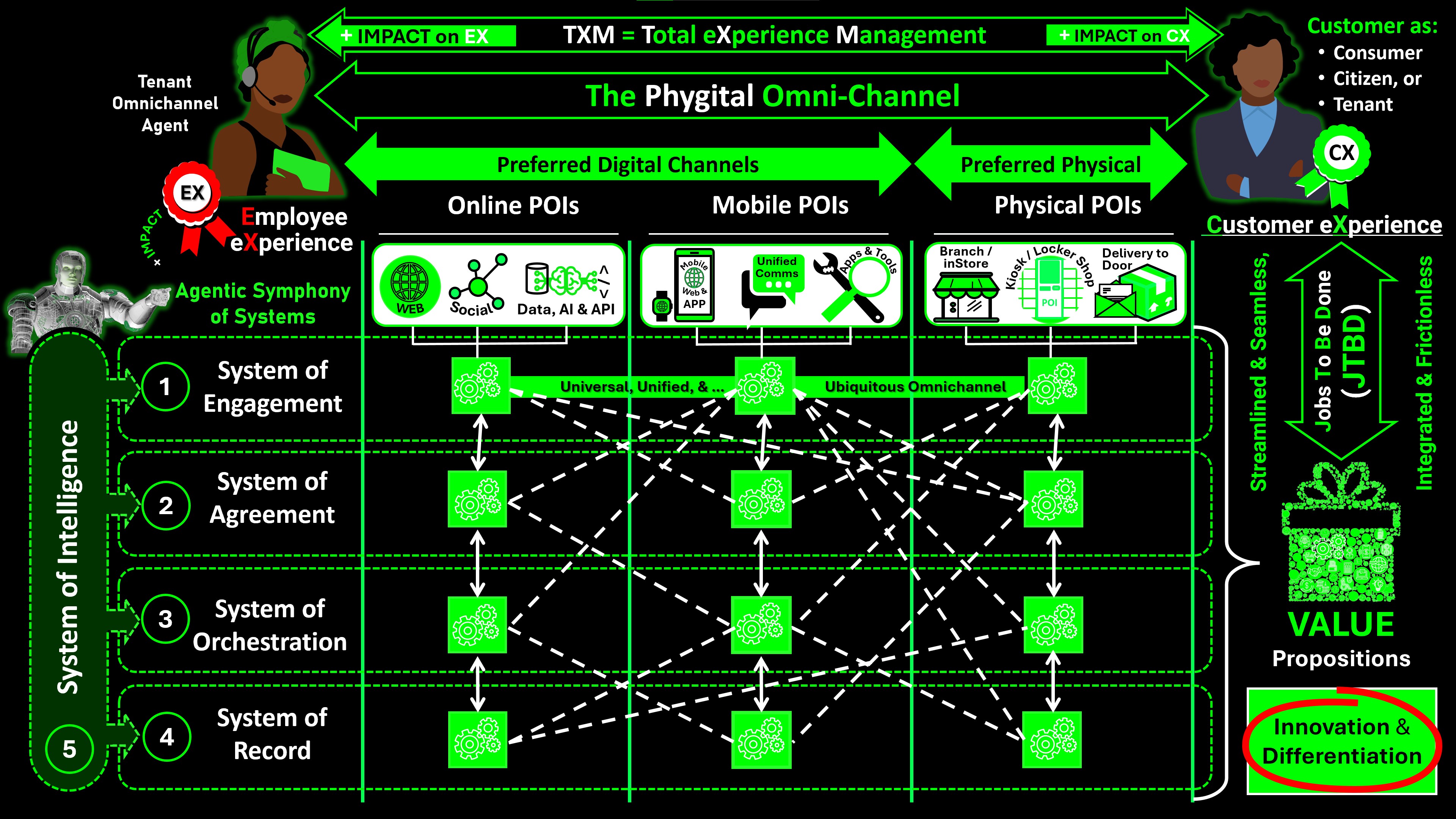
Total eXperience Management
The Phygital Omni-Channel connects Employee eXperience (EX) on the left with Customer eXperience (CX) on the right – across Online POIs, Mobile POIs, and Physical POIs – through all six system layers simultaneously.
This is Total eXperience Management (TXM): the structural guarantee that every touchpoint – from a drive-through POI Appliance to a rural community HUB – delivers frictionless, governed, and fully auditable interactions.
Salient Innovation Set & FinTech Core Unity
The overarching framework is the Salient Innovation Set. At its foundational core lies the Salient FinTech Innovation Set. Every phygital, civic, healthcare, retail, or agentic interaction ultimately resolves into a lawful value exchange, identity binding, cryptographic settlement, or fiduciary obligation; therefore, the FinTech innovation set – encompassing BIAN bare-metal execution, real-time A2A rails, SEPA Instant, Token Gantry, and bitemporal ledgers – provides the non-negotiable trust engine that makes the entire sovereign ecosystem viable for all incoming Tenant Cohorts.

POS & POI Interaction
Physical and digital points of interaction execute verifiable handshakes. Autonomous devices bind human identity to session contexts without transmitting raw credentials.

A2A Payment Rails
Sub-second account-to-account settlement via SEPA Instant and national rails, cutting legacy interchange intermediaries completely out of the execution loop.

Consent Contracts
Cryptographically bounded permissions enforced by the DRAGON engine. Personal data disclosure occurs strictly on a need-to-know zero-knowledge basis.

Agreement DAGs
Bitemporal state graphs that formalise tripartite commitments across citizens, merchants, and sovereign regulatory frameworks before execution starts.
Target State Architecture Metrics
The following performance figures represent forward-looking target metrics for our near-term target state architecture (Q4 2026 / 2027 roadmap). They reflect formal engineering design goals under laboratory validation and do not represent historical or current operational metrics.
| Metric Domain | Architectural Layer | Near-Term Target (Q4 2026 / 2027) | Formal Verification Criteria |
|---|---|---|---|
| Adjudication Latency | DRAGON Hardware Engine | < 45 µs | FPGA / ASIC triadic gate-level verification |
| A2A Settlement Finality | Real-Time Payment Rails | < 500 ms | SEPA Instant / FedNow end-to-end confirmation |
| PII Exposure Boundary | Cryptographic Shredding | Zero Plaintext | Ephemeral key destruction with ZK integrity proofs |
| Bitemporal State Proof | System of Record (SoR) | < 200 ms | Dual-timestamped state audit path generation |
| Ecosystem Availability | TRS-MS Bedrock Consensus | 99.999% SLA | Byzantine fault tolerance across federated nodes |
The Death of Post-Hoc Auditing
The Symphony of Systems represents a fundamental shift: from "detect and respond" to predict and prevent. Risk is structurally eliminated via the Fail-Closed by Constitution invariant. Auditability becomes a matter of Deterministic Recomputation, not forensic investigation. The Constitutional OS is the specification that governs how all five systems behave as a unified whole – read it to understand the axioms that make this possible.
Parametric Cognition Governance (PCG): Replacing the "Parametric Cognition Governance" Metaphor
Engineered for enterprise architects and digital transformation leaders, the Symphony of Systems (SoS) unifies enterprise operations into six harmonised layers (SoE, SoA, SoO, SoR, SoI, TRS-MS). Eliminate data silos, streamline business capability execution, and achieve total operational visibility across legacy and next-gen infrastructure.
Read Warwick Metcalfe's Full PCG Whitepaper →System of Engagement: The Sentient Strings Section
The System of Engagement (SoE) executes Total Experience Management (TXM) by unifying Employee Experience (EX), Customer Experience (CX), and Product Experience (PX) into a single governed runtime. Inverting traditional "Trust Me" marketing into Substantiated Integrity BX backed by real-time hardware-enforced cryptographic evidence.